
Reviewing Available Options for Acquiring State Office Space
Introduction
Senator Rick Billinger requested this audit, which was authorized by the Legislative Post Audit Committee at its April 10, 2025 meeting.
Objectives, Scope, & Methodology
Our audit objective was to answer the following questions:
- How much office space is owned or leased by the state and how is that space being used?
- What cost-effective options are available for state agencies to acquire office space in Topeka?
The scope of our work included reviewing all state agency office space locations across the state during fiscal year 2025 and how those locations were acquired. To conduct this work, we requested information from all state agencies about the location, size, and cost of their office space, and the number of staff at those locations. We also spoke with agency officials to better understand the information. Additionally, we interviewed Department of Administration officials and reviewed government reports to understand the different options available for agencies to acquire office space.
More specific details about the scope of our work and the methods we used are included throughout the report as appropriate.
Important Disclosures
We conducted this performance audit in accordance with generally accepted government auditing standards. Those standards require that we plan and perform the audit to obtain sufficient, appropriate evidence to provide a reasonable basis for our findings and conclusions based on our audit objectives. Overall, we believe the evidence obtained provides a reasonable basis for our findings and conclusions based on those audit objectives.
Audit standards require us to report limitations on the reliability or validity of our evidence. In this audit, we relied on information agencies reported about their office spaces because it is not tracked statewide. Because the information is self-reported, we can’t verify that agencies accurately and consistently reported all their office space locations, costs, square footage, and staffing. We reviewed the information that agencies provided for obvious errors that would affect our findings. We also compared agencies’ data to the Department of Administration’s lease reports and checked it for mathematical errors. When information did not make sense or appeared to be reported incorrectly, we worked with agencies to verify or modify the data. However, there may be some minor errors or inconsistencies in agencies’ data. Those errors could lead to changes in numbers or percentages but are unlikely to significantly change our overarching conclusions.
Our audit reports and podcasts are available on our website www.kslpa.gov.
In fiscal year 2025, state agencies reported 4.1 million square feet of office space statewide and that most of that space is actively being used by state employees.
Background
State agencies purchase or lease space to meet a variety of needs ranging from office work to storage to public services.
- State agencies need a variety of spaces to implement their diverse programs and missions. For example, state employees are responsible for maintaining roadways, securing prisons, conducting lab work, and assisting individuals with state and federal benefits. This requires state agencies to have many different types of space such as prisons, labs, data centers, and courtrooms. Some of these locations include office space for state employees, but others include space for purposes like housing large equipment (e.g., garages for Department of Transportation vehicles) or public recreation (e.g., Department of Wildlife and Parks state parks).
- This audit is limited to spaces that contain at least some office space. We defined office space as any space that agencies use for office-based work. This includes areas agencies use as offices for administrative or program staff, small storage spaces (like closets), and conference rooms. Locations that agencies use exclusively for other purposes like housing equipment are not included in this audit.
- Agencies have 2 main options for acquiring space.
- A state agency can purchase an existing private building or build a new one. There are 2 general options for purchasing—a direct purchase or a lease-purchase agreement. A lease-purchase agreement is a rent-to-own contract where an agency agrees to purchase the property in the future.
- A state agency can contract with another party to lease office space. Agencies may lease privately owned property, or they may lease state-owned property through the Department of Administration (DOA). DOA manages 6 state-owned buildings in Topeka (the Curtis, Docking, Eisenhower, and Landon state office buildings, Memorial Hall, and the Kansas Department of Health and Environment lab) that agencies can lease space in.
- Agencies also can acquire office space through other arrangements that are less common and based more on an individual agency’s circumstance. For example, a few agencies have space-sharing agreements with the federal government or a local college or university.
State agencies have discretion in determining what office space they need and how to acquire it.
- State agencies decide what their space needs are, where they want to locate, and whether they want to purchase or lease office space. The process for acquiring space varies depending on whether an agency purchases or leases space (and which type of lease they pursue). Department of Administration staff (DOA) can facilitate agencies as they go through this process. For example, DOA provides forms that agencies can use to identify their space needs, estimate and consider expenses, and find required procedures for finding, bidding, and securing a lease.
- DOA approves all state agencies’ lease agreements. For example, DOA must review and approve agencies’ lease agreements with a private landlord. Agencies that lease space in a state-owned building don’t sign a lease agreement or other formal contract, but DOA is responsible for making the arrangements for those spaces.
- Finally, the legislature approves office space purchases through the appropriations process and also approves certain lease agreements for privately owned spaces. Additionally, the Secretary of Administration is required to inform and consult with the Joint Committee on State Building Construction before approving leases of privately owned space of more than 10,000 square feet or for longer than 2 years.
- None of these processes or approvals require agencies to formally compare the advantages, disadvantages, and costs of leasing office space to purchasing office space. Instead, the processes consider many factors, of which costs are only one factor. For example, agencies consider how soon and how long they need the space, and how much flexibility and control they have over it.
The information in this report is self-reported by agencies because the state doesn’t have a central repository for all agency-owned office space.
- We collected office space information directly from state agencies. This is because DOA does not maintain a comprehensive database of all state property with the information we needed for this audit. DOA has some information about the 6 buildings they manage but officials told us they did not have complete information about property owned by other state agencies. DOA also has some information about leased property, but officials told us that data may be outdated and incomplete due to agency reporting.
- We sent an information request to 80 state agencies. All 80 agencies responded. This included all executive, legislative, and judicial branch agencies, and the Governor’s Office. 2 agencies reported they did not have any office space because of their size (they both reported having less than 1 full-time staff who work from their homes). Therefore, later sections of this report include data for 78 state agencies.
- Some of the 78 agencies include multiple entities. For example, we counted the Department of Corrections and the state’s correctional facilities as one agency.
- We did not request information from state universities, school districts, district courts, and quasi-governmental agencies. Although those agencies receive state funding, the property they own or occupy is not necessarily owned by the state. For example, district courts may operate out of local government courthouses.
- All information we gathered was reported by agency officials. We looked for obvious errors that would affect our findings. We also compared reported information to DOA lease reports and checked work for math errors. However, we couldn’t verify all information that every agency reported, which means it may include some minor errors or inconsistencies. Those errors could change exact numbers or percentages but are unlikely to significantly change our overarching conclusions.
- We asked agencies to report information about their office spaces for fiscal year 2025. This includes offices, small storage spaces (like closets), and conference rooms that are for the agencies’ exclusive use. Agencies reported the locations, square footage, rent rates, and other occupancy expenses of their office spaces. They also reported basic information about lease agreements, what spaces are used for, and the number of employees who are typically at each location. However, office space holdings are not static, and the amount of office space the state has can change over time.
- We asked agencies to report all office space they have. This includes locations that are exclusively office space and locations that only have a small amount of office space. For example, the Kansas State Fair has a maintenance shop in Hutchinson. About 10% of the square footage in the maintenance shop is office space, which we included in our analysis. If there was no office space attached to a location, like a public recreation facility, we did not include it in our analysis.
State Office Space in Kansas
In fiscal year 2025, state agencies reported owning or leasing 4.1 million square feet of office space across the state.
- Figure 1 summarizes the location of agency-owned or leased office space. It shows that agencies have office space in 102 out of 105 counties (Elk, Stanton, and Wichita counties are the exception). The figure also shows that agencies have the most office space locations in Shawnee, Sedgwick, and Johnson counties.
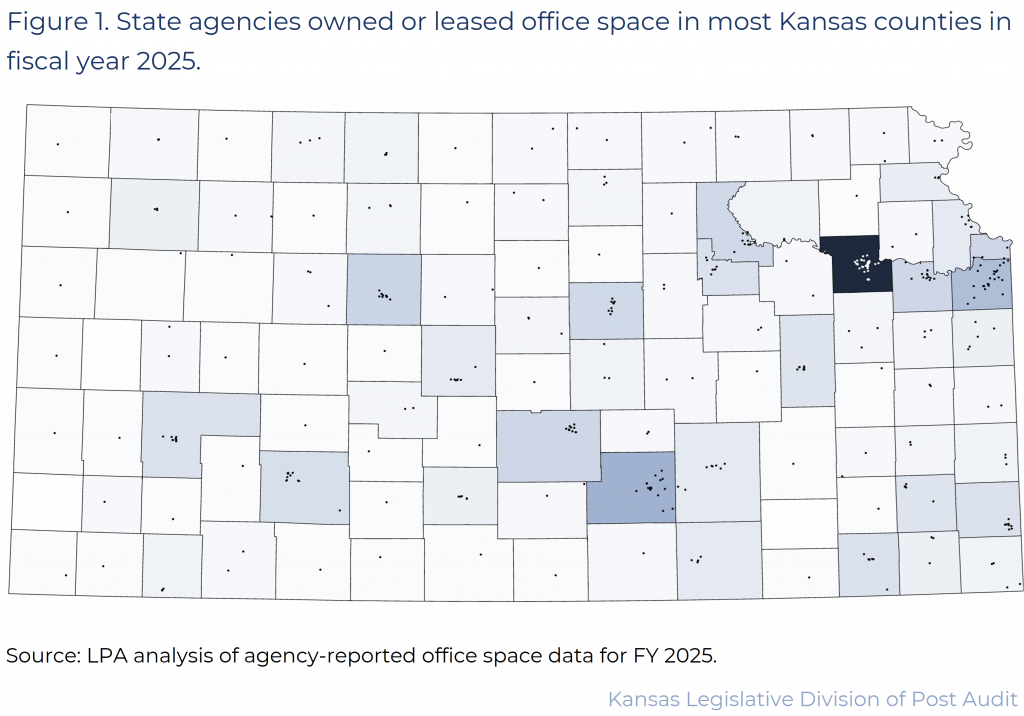
- All 78 state agencies reported having about 4.1 million square feet of office space across 524 locations statewide. They acquired these properties through leasing, purchasing, or other mechanisms such as space-sharing agreements. Appendix B provides an overview of the information the 78 state agencies reported. This includes the amount of office space each agency holds, their average cost per square foot, and whether they own or lease space.
- Most of this office space was in Shawnee County. 68 agencies reported having 2.4 million square feet of office space in Shawnee County. This accounts for about 60% of all state agency office space in Kansas.
In fiscal year 2025, state agencies leased around 63% of their office space.
- Figure 2 summarizes the different ways agencies acquired state office space as of fiscal year 2025. It shows that agencies leased more space than they owned. 63 agencies leased 2.6 million square feet (63%) of office space across the state.

- Agencies leased most of their office space from private owners. They leased 1.8 million square feet (67%) of office space in privately owned buildings and about 850,000 square feet (33%) of office space in state-owned buildings.
- Agencies leased most of their space in Shawnee County. They leased 1.6 million square feet (62%) of office space in Shawnee County and about 982,000 square feet (38%) of office space in other Kansas counties.
- The Kansas Department for Children and Families, the Kansas Department of Health and Environment, and the Kansas Department of Revenue leased the most office space of any state agencies in fiscal year 2025.
- The Department for Children and Families leased about 715,000 square feet of office space in 35 counties. The department reported that they used this office space to do things like provide prevention and protection services near the communities where residents live.
- The Kansas Department of Health and Environment leased about 406,000 square feet of office space in 11 counties. The department’s office space includes 6 district offices through which the department administers environmental programs.
- The Kansas Department of Revenue leased around 223,000 square feet of office space in 33 counties. The department reported using this office space to operate driver’s license centers and conduct administrative work.
In fiscal year 2025, state agencies owned about 32% of their office space statewide.
- State agencies reported owning 1.3 million square feet (32%) of office space as shown in Figure 2.
- 17 agencies own and use their own property. This is different than the 6 buildings the state owns in Topeka but leases to various state agencies. For example:
- The Kansas Department of Transportation (KDOT) owned the most office space of any state agency in fiscal year 2025. They reported owning around 374,000 square feet of office space in 101 counties. Most of this office space was located at KDOT yards and maintenance facilities throughout the state that are used to support road work.
- The state hospitals owned about 349,000 square feet of office space in 4 counties. This office space was located at the Kansas Neurological Institute and Larned, Osawatomie, and Parsons state hospitals.
- The Kansas Department of Corrections owned about 172,000 square feet of office space in 8 counties. All of this office space was located at state adult and juvenile correctional facilities.
- Most agency-owned office space was outside of Shawnee County. Agencies owned about 610,000 square feet (46%) of office space in Shawnee County and about 727,000 square feet (54%) of office space in other Kansas counties
Agencies had other arrangements for about 5% of their office space.
- Most of the remaining 189,000 square feet (5%) of reported office space is in the Kansas State Capitol or Kansas Judicial Center. Legislative and judicial agencies as well as the Office of the Governor reported occupying 143,000 square feet between both locations. They do not pay for their space. Instead, the operational costs of the State Capitol and Judicial Center are covered through a monumental building surcharge. State agencies that lease space in Shawnee County pay the surcharge ($3.30 per square foot).
- Only 1 state agency reported having a lease-purchase agreement in fiscal year 2025. The Kansas Department of Corrections reported that the Lansing Correctional Facility was acquired through a lease-purchase agreement. They told us the facility had about 32,000 square feet of office space for corrections staff.
- Finally, some agencies also acquired a small amount of office space through space-sharing agreements. For example, the Kansas Office of Veterans Services reported that the United States Veterans Administration provides office space to them in 4 different locations with no reported costs for the space. This includes an office at the Topeka VA medical center. Additionally, the Kansas Department of Wildlife and Parks has space sharing-agreements with the United States Army Corps of Engineers at different Kansas state park locations. The department also reported no costs to use these spaces.
As far as usage, agencies reported most office space was occupied.
- As part of this audit, legislators expressed interest in understanding how state agencies used office space. They wanted to know whether state employees used agencies’ office space all the time, part time, or not at all.
- To determine whether state agencies used the space they had, we asked all 78 state agencies to report if they had office space that wasn’t occupied and how long it had been unoccupied. Agencies only reported 16 of 524 office space locations across the state had unused space. These locations were a combination of agency-owned spaces, leased spaces, and spaces acquired through space-sharing agreements. We didn’t ask agencies how much space at those locations was unoccupied.
- State agencies reported 4 locations had been unoccupied for more than 5 years. 3 of these locations had space that was unfit for people to occupy because of mold or asbestos. For example, the Kansas Neurological Institute had a building with mold and a leaky roof that they were considering razing. The Department for Children and Families reported a fourth location that they said state employees use to provide disability determination services through a contract with the federal government. Department officials said the unused space was due to federal hiring freezes. They also reported the federal government paid 99.5% of the cost for that location.
- State agencies reported 12 locations had been unoccupied for 5 years or fewer. 5 locations had been unoccupied for less than 1 year and 7 locations had been unoccupied for 1 to 5 years. In these instances, agencies reported the space generally ranged from a single office to a few cubicles of office space. Officials reported the space wasn’t used because of staff vacancies or future plans to hire additional staff.
- Further, we asked agencies to report the average number of FTEs who worked onsite daily and compared it to the amount of office space they reported to determine the average square footage per FTE at each location. We did this work to estimate if agencies’ office spaces were fully or partially occupied. However, we ultimately weren’t able to make a determination because agencies’ needs for space vary dramatically and buildings are configured very differently.
- To ensure a consistent comparison, we limited our analysis to 196 locations across the state that agencies reported were primarily used as office space (out of the 524 total office space locations agencies reported).
- State agencies reported employees at these locations used a wide range of space. They reported employees used 45 to 3,500 square feet per FTE, with an average of about 375 square feet per FTE.
- This was higher than some standards recommend (about 150 to 250 square feet per FTE) but we ultimately couldn’t determine if that was appropriate because of the variation in how state agencies use and configure their office spaces. For example, the Department of Health and Environment reported some staff have flexible schedules and the Department for Aging and Disability Services reported some staff work primarily in the field. These factors may make it seem like some agencies have more space per FTE than they need, but that may not be the case.
Most agencies also reported they had enough space if all employees were asked to work in the office.
- In recent years, the legislature has considered requiring state employees to work onsite in an office. However, some agencies have expressed concerns because their staff do work that doesn’t make sense to do from an office. For example, some agencies have staff who work in the field nearly every day conducting inspections or meeting with clients, which doesn’t require them to have office space. Other agencies have expressed concerns because they are very small and do not have office space. For example, the Kansas Board of Examiners in the Fitting and Dispensing of Hearing Instruments has 1 employee who works part time and who works from their home. If all state employees were required to work in the office, these agencies would need to obtain space for employees who formerly didn’t have any space. We asked agencies to report if they would need more space for all employees to work onsite to provide high-level data for these discussions.
- We asked state agencies about their capacity to accommodate all employees working onsite at the 524 locations agencies reported to us. 70% of agencies (54 of 78 agencies with office space) told us they had enough space for all employees to work in the office. The other 24 agencies said they did not. These agencies ranged in size from small agencies like the Kansas Board of Cosmetology, to larger agencies like the Kansas Department of Education or the Kansas Department of Agriculture.
- We did not ask agencies to explain why they would not have enough office space for all employees to work onsite.
Other Findings
Most lease agreements in privately owned buildings are less than 10 years in length and can’t be broken unless state funding is terminated.
- As part of this audit, legislators expressed interest in understanding the length of agencies’ leases. We asked 43 agencies who reported leasing office space in privately owned buildings to report the length of their original lease agreements. These agencies reported 241 private leases. Figure 3 summarizes the varying lengths of these lease agreements. It shows that while original lease lengths ranged anywhere from 1 year to more than 20 years in length, most lease agreements were short-term leases. The most common length of agencies’ original leases was 5 to 9 years.

- Around 90% of the 241 private leases that agencies reported would not require agencies to pay a financial penalty to break their lease. However, the standard provision in most private lease agreements only allows state agencies to break the lease if state funding is terminated by the legislature for fiscal necessity.
- Agencies reported the other 10% of the 241 private leases assessed a penalty for breaking the lease. As of July 2025, it would cost agencies a collective $16.5 million to break their current leases. The largest penalty would be about $4 million for each of 2 Kansas Department of Revenue locations in Topeka. The smallest penalty would be about $5,000 for a Kansas Department of Labor location in Garden City. We did not review individual agency leases so we do not know if these agreements would allow state agencies to break the lease for reasons beyond state funding being terminated for fiscal necessity.
- We did not review the length of agencies’ lease agreements for office space in state-owned buildings. This is because they do not have a signed lease agreement. Instead, agencies leasing office space in a state-owned building may increase or decrease the amount of space they lease on a quarterly basis with no penalty.
For state agencies in Topeka, it appears the primary option for acquiring office space is to lease space in privately owned buildings or state-owned buildings.
Leasing appears to be the most common option for state agencies to acquire office space in Topeka.
- In Topeka, most agencies lease office space but very few agencies own office space. Of all 78 state agencies, 52 agencies reported leasing office space in Topeka, 6 agencies reported owning office space in Topeka, and 4 agencies reported owning and leasing space in Topeka.
- Department of Administration (DOA) officials said agencies have the option to lease office space in state-owned or privately owned buildings, but there are fewer options to purchase office space in Topeka. For example, DOA officials told us that private owners didn’t identify their properties as being for sale when DOA inquired about such properties in the past. They also told us the lease template they ask agencies to use includes the terms for a lease-purchase option, but private owners often aren’t interested in these types of arrangements. DOA officials told us that private owners view their properties as long-term investments and do not typically want to sell them.
- DOA officials also told us that agencies are typically more interested in leasing property than purchasing property for several reasons. For example, they said agencies that lease office space don’t have to worry about maintenance expenses on large-ticket items, they have more ability to grow or shrink office space as needed, and there are fewer steps needed to lease space than purchase space.
- Finally, at the time of this audit, it appeared that more office space was available to lease than to purchase in the Topeka market. Online commercial office space listings in September 2025 showed that 10 private office space properties were available to purchase. On the other hand, 20 private office space properties were available to lease. We cannot say if any of these sites would be a good fit for state agencies.
- Because so few agencies own office space in Topeka, we could not compare the cost-effectiveness of leasing space to purchasing space. We also couldn’t determine how much it costs DOA to maintain the state-owned buildings in Topeka due to data constraints as described later in the report. Therefore, our analysis focuses on comparing the costs of leases in state-owned buildings and privately owned buildings in Topeka.
In fiscal year 2025, state agencies in Topeka reported leasing costs for privately owned buildings were less than state-owned buildings.
- State agencies in Topeka reported leasing space in privately owned buildings across 49 locations. We reviewed information agencies reported about the cost of 40 out of those 49 privately leased locations in Topeka. We excluded 9 locations that were not used primarily as office space or that used federal dollars to fund leasing costs.
- We asked agencies to report the fully loaded leasing costs for all usable space in privately owned buildings.
- Usable space is different than the office space we described earlier in the report. Usable space includes the total square footage agencies leased in buildings, not just the square footage they used for office space. For example, usable square footage includes space agencies use for offices plus space for corridors and reception areas. We used the amount of usable space for this work because agencies’ leases include the cost for all space, not just the cost for office space. Calculating the cost-per-square-foot of only office space could make the cost appear higher and create an inaccurate comparison.
- The fully loaded leasing costs included the amount agencies paid in rent plus any additional costs to occupy the space (like cleaning or maintenance expenses). It also included the $3.30 monumental surcharge per square foot that most agencies leasing space in Shawnee County are required to pay. DOA officials told us that the surcharge helps cover upkeep costs for the Capitol, Cedar Crest (the Governor’s Mansion), Judicial Center, and state parking lots.
- We compared the rate that agencies reported paying for usable space in privately owned buildings to the rate agencies reported paying for usable space in state-owned buildings. Figure 4 shows the cost-per-square-foot that state agencies paid to lease space in privately owned buildings and state-owned buildings in Topeka in fiscal year 2025. As the figure shows, nearly all leases for privately owned space were less expensive than leases for state-owned space. The average cost to lease privately owned space was about $21.00 per square foot and the average cost to lease state-owned space was $25.40 per square foot. In other words, private leases were about $4.00 per square foot less than the cost to lease state-owned space.

- DOA officials described 3 factors that may explain why the cost-per-square-foot to lease state-owned space was generally higher.
- They told us that the state lease rate includes the cost to cover future building improvements. This means agencies that lease state-owned space pay a portion of improvement costs even when those improvements don’t involve their agency.
- DOA officials also told us the state rate includes the cost of non-leasable space (like cafeterias that are shared across agencies leasing the space) in the 6 state-owned office buildings (Curtis, Docking, Eisenhower, Landon, Memorial Hall, and the Kansas Department of Health and Environment lab) as well as debt service for 2 of those same buildings. This could cause the state rate to be higher than private lease costs if private buildings have less non-leasable space or don’t have debt service remaining. According to DOA testimony, about 25% of the space in the Curtis, Eisenhower, Landon, and Memorial Hall buildings is non-leasable. We don’t know how much non-leasable space is in the privately owned buildings that state agencies lease.
- DOA officials said they provide services or amenities private lessors may not provide, including things like access to exercise areas and the network fiber loop and virtual server platform managed through OITS.
- We can’t fully explain why the state lease cost generally appears to be more than private lease costs. It could be due to a variety of factors like those described by DOA officials. However, it could also be due to the age or condition of the buildings or that DOA may not be calculating state lease costs correctly. Finally, it’s also possible some agencies reported fewer occupancy expenses than they actually have. For instance, they may not have included additional costs for parking or security services even though we asked them to. This would make the total cost-per-square-foot lower than it actually is. However, we don’t have any reason to think that agencies consistently underreported these amounts in a way that would significantly change our conclusion.
The annual cost to own space in Topeka is unclear because few agencies own space and DOA data on state-owned office buildings wasn’t reliable.
- We tried to collect cost data from agencies that own their office space (like the Department of Labor and the Kansas Public Employees Retirement System) so that we could compare purchasing costs to leasing costs. However, only a few agencies with office space in Topeka own their locations and they reported no debt service costs remain for those spaces. This means those agencies’ costs aren’t a good approximation for what it would cost state agencies to purchase a new building.
- We also tried to collect cost data from DOA about 4 of the state-owned office buildings they manage (i.e., the Curtis, Eisenhower, and Landon state office buildings and Memorial Hall) to estimate the cost to own space in Topeka. We asked DOA to explain how they determine the costs to operate those buildings because that’s factored into the state’s lease rate. DOA told us they use a series of spreadsheets to calculate the cost to operate state buildings, which involves things like allocating salaries and debt service costs. They use those costs to determine the state lease rate.
- However, we couldn’t analyze the cost data DOA provided to us for state-owned buildings for fiscal years 2022 through 2024 because it wasn’t reliable. We identified a series of calculations and numbers that didn’t make sense and that DOA officials couldn’t explain. For example, several totals didn’t sum correctly or conflicted with other subtotals, overhead costs were inconsistently allocated, some salary expenses and debt service costs were incorrect, and several expense categories (e.g., contractual services, commodities) varied significantly across years.
- DOA officials told us they couldn’t resolve the issues we identified in their cost data because of frequent turnover in DOA finance staff.
- This means we and DOA officials can’t confidently report how much it costs DOA to maintain state-owned buildings. It also means we can’t compare the cost-effectiveness of purchasing office space in Topeka to leasing office space in Topeka. If DOA doesn’t have reliable data on operating costs, it also creates a risk that DOA may set a state lease rate that either overcharges or undercharges agencies for office space in state buildings.
Agencies’ decisions to lease or purchase office space are based on several factors, some of which are non-financial.
- In Kansas, state agencies don’t have to follow a specific process to compare the advantages and disadvantages of leasing or purchasing office space. DOA doesn’t systematically evaluate if state agencies are making the most cost-effective decisions when they select office space. Instead, state agencies decide what locations are best for their agency on a case-by-case basis. Agencies generally must receive approvals from either the DOA or the legislature for the office space they select, but those approvals are high-level and don’t compare detailed costs or non-financial factors across available options.
- Agencies need to consider a lot of factors when deciding how to acquire space and what space to acquire. Some of these factors are related to costs both short term and long term. Other important factors are non-financial, such as availability, flexibility, amenities, and logistical requirements.
- Both leasing and purchasing can be cost-effective options depending on an agency’s circumstances and priorities. For example, benefits of leasing can include no costs on the front end for financing, the ability to change locations if it’s not a good fit for the agency, and not having to pay for large, unexpected repairs. Comparatively, the benefits of purchasing can include more control over the location, building financial value in the space (equity), and lower regular long-term expenses after the space is paid for.
Other Findings
About a quarter of the space in the newly renovated Docking State Office Building is office space, and most of that space will be filled with 4 agencies.
- The Docking State Office building houses office and meeting space for state employees and an energy center to service buildings in the capitol complex in Topeka. The building was built many years ago and slowly deteriorated over time. DOA and the legislature discussed numerous options to refurbish the building. Ultimately, they committed to razing the above-ground portion of the original building and to build 3 new floors. Construction on the new building was completed in 2025 and fully paid for with $79 million in federal American Rescue Plan Act funds and $60 million in state general funds.
- Around 25% of the Docking building is leasable office space. DOA reported in March 2025 that the building had about 277,000 square feet of space. Of that, about 73,000 square feet was leasable office space. Officials provided legislative testimony that the remaining around 200,000 square feet contained non-office space for things like a gym and café, as well as the original power plant that remained in the basement levels of the building. They said a portion of that 200,000 square feet also includes spaces that can’t be leased because they are for building maintenance and cleaning crews.
- As of August 2025, DOA planned for about 64,000 square feet of the 73,000 square feet of leasable office space to be occupied by certain divisions within the Department of Commerce, the Department of Administration, and the Kansas Highway Patrol as well as all Secretary of State divisions. The remaining 9,000 square feet of leasable office space was not assigned to an agency.
- There was no formal application process for the 4 agencies selected to move into new spaces. DOA officials told us they selected agencies based on several factors that included the geographic location of the agency, how efficiently DOA could back fill vacant locations when an agency moved to Docking, and if they could consolidate agencies into single office spaces. For example, by moving the Secretary of State to the Docking building it would allow the Attorney General to bring more of its people into the same space. That’s because the Attorney General could backfill the space formerly occupied by the Secretary of State instead of having their staff disbursed across several buildings.
- The move to Docking will leave portions of other state office buildings vacant. DOA officials reported that the various divisions of the Attorney General’s Office will move their offices into Memorial Hall. DOA officials also reported that space in the Curtis State Office Building vacated by Commerce will be filled by the Kansas Highway Patrol’s general headquarters. Aside from that, DOA officials told us they were working with other agencies to determine how the vacated spaces might meet their needs.
Conclusion
State agencies own or lease a large amount of office space throughout the state that agencies report is generally being used. Kansas doesn’t have a regimented, formal process where a single agency examines agencies’ needs and determines the best option for both square footage and leasing versus owning. Instead, agencies have a lot of discretion in determining what works best for them. As a result, we can’t say whether agencies are acquiring and using that space as efficiently or effectively as they could, because each agency’s circumstances are different. State agencies with locations in Topeka may not have many options to purchase office space anyway. That’s because it’s uncommon for the state to build new buildings or purchase existing office space in Topeka. Agencies either lease existing privately owned space or lease space in existing state-owned buildings. As a result, there’s little data available to compare the costs of purchasing to the cost of leasing office space.
Recommendations
- The Department of Administration should create detailed instructions about how finance staff need to compile and calculate costs to operate state-owned buildings and about how to calculate the state lease rate.
- Agency Response: The Department of Administration (D of A) agrees that detailed written instructions outlining the process for obtaining the cost to operate state buildings and to develop reasonable rent rates is a critical step to have completed. This is an issue that D of A has discussed internally throughout the audit process and will implement prior to the next time rates are calculated. D of A has seen an inordinate amount of employee turnover within the office that creates rent rates, leading to a lack of institutional knowledge. This only further underscores the need for documenting such a process.
D of A is in the process of exploring how our current budget reporting software can better interface with our accounting system, in an effort to automatically develop rates. The software that is utilized for reporting monthly progress against budgets is relatively new, so this solution would need to be vetted and validated prior to implementing it as a permanent solution, should it be a viable option.
In the interim, D of A has already begun the process of scrubbing the existing spreadsheets where data is entered in order to calculate a total rate. These spreadsheets will be redesigned from the ground up, and each input will be validated as an accurate and necessary component of the rent rate calculation. As the spreadsheet is developed, detailed instructions on where to gather the source data, and how to update the spreadsheet and finalize the calculation will be created. Additionally, the office responsible for calculating the rent rates will ensure that multiple staff members are cross trained on this process, to ensure continuity in the event of future staff turnover.
Agency Response
On October 6, 2025, we provided the draft audit report to the Department of Administration. Its response is below. Agency officials generally agreed with our findings, conclusions, and recommendations.
Department of Administration Response
Dear Ms. Smith:
The Department of Administration (D of A) appreciates the opportunity to respond to the Reviewing Available Options for Acquiring State Office Space audit (the audit), conducted by the Kansas Legislative Division of Post Audit (LPA). The staff from LPA were professional and courteous, and they showed a willingness to communicate directly with, and to accept new information from D of A staff, as they worked through the audit. We appreciate the cooperative spirit with which they approached the audit, as well as their thorough review.
D of A prides itself on providing quality customer service and for serving as the State’s landlord for agencies that choose to occupy space in the Capitol Complex. We take our statutory responsibility to care for the Capitol Complex and the surrounding grounds very seriously, and we strive to provide a safe, secure, and efficient workspace for agencies that choose to operate from within state-owned buildings. For agencies that choose to lease space from a privately owned building, we always stand ready to assist with their search, and we review the merits of the rates they are being assessed. Our team has developed strong working relationships with real estate groups across Shawnee County, and we strive to represent the State as a reliable and reputable lessee.
There is one section in the audit that makes a reference to the price of leasing private office space being less expensive than the cost to lease state owned property. While D of A has no concerns with the data presented by LPA, it is important that we provide some context for this comparison. The audit appropriately explains many of the nuances that are involved when comparing costs, as well as laying out some of the potential drivers of the variance, but D of A feels that providing context here and reinforcing the work of the audit is a worthy endeavor.
While it is mentioned in the audit, it bears repeating that the costs that are captured for private leases reflect the rates that tenants are paying in fiscal year 25 based on their current lease agreements, many of which were signed years ago. These rates reflect what the market would assess at the time the lease was negotiated, and it might not match what the market would assess today. Stated differently, if a tenant is currently paying a lease rate of $18.00 / square foot (as an example), with a lease that expires on 12/31/2026 (again, as an example), then the landlord might not be willing to offer the same rate per square foot for that space on 01/01/2027. We have seen dramatic upward shifts in the cost of real estate over the past five years, as is reflected in housing and commercial prices all across the state. Many of the leases identified in the underlying data set for this section of the audit expire in the next two years, meaning agencies will need to negotiate rates with these landlords to extend their lease agreements, or will need to find new space.
To be clear, D of A is not disputing that many of the leases of private office space are lower than those of state-owned space. As pointed out in the audit, D of A is charged with the care of the entirety of all state buildings, including space that is not leasable, which may drive up our cost. The audit further points out that D of A is accountable for making debt service payments on two Capitol Complex buildings, the cost of which is baked into the assessed lease. It is D of A’s intent to continue to conduct a thorough review of the costs associated with operating state-owned buildings, and to only charge agencies what is necessary to maintain these assets in good repair. Additionally, we are exploring ways that we can commit to a multi-year lease rate and monumental surcharge, as opposed to recalculating our rates annually. Doing so would provide stability for state agencies and would be more reflective of how a traditional landlord operates.
D of A leadership stands ready to answer any questions that the committee – or any legislator – has about how we maintain our buildings.
Sincerely,
Adam C. Proffitt
Secretary of Administration
Appendix A – Cited References
This appendix lists the major publications we relied on for this report.
- Federal Buildings: Agencies Focus on Space Utilization as They Reduce Office and Warehouse Space (March, 2018). United States Government Accountability Office.
- Federal Real Property: Agencies Need New Benchmarks to Measure and Shed Underutilized Space. (October, 2023). United States Government Accountability Office.
- State of Kansas Office Space Standards (2003, online as of September 2025). Kansas Department of Administration.
Appendix B – Office Space by State Agency
This appendix shows each state agency and key information they reported about their office space statewide. This includes the total square footage of office space they own or lease, the number of locations with at least some office space, the way they acquired those spaces, and the associated costs.
|
Agency Name |
Total Square Feet of
Office Space (a) |
# of Locations with
Office Space |
Own Or Lease |
FY 2025 Average Cost Per Square Foot |
FY 2025 Total Occupancy
Costs (a) (b) |
|
Department for Children and Families |
715,000 |
39 |
Lease |
$
16.65 |
$
15,000,000 |
|
Department of Transportation |
536,000 |
131 |
Both |
$
5.30 |
$
7,400,000 |
|
Department of Health and Environment |
406,000 |
17 |
Lease |
$
21.21 |
$
12,900,000 |
|
Department of Corrections (c) |
317,000 |
27 |
Both |
$
17.04 |
$
1,900,000 |
|
Department of Revenue |
223,000 |
42 |
Lease |
$
23.32 |
$
7,400,000 |
|
Kansas Neurological Institute |
180,000 |
1 |
Own |
$
5.92 |
$
1,100,000 |
|
Kansas Bureau of Investigation |
138,000 |
9 |
Both |
$
3.70 |
$
800,000 |
|
Department of Labor |
130,000 |
7 |
Both |
$ 6.10 |
$
800,000 |
|
Indigents Defense Services |
89,000 |
15 |
Lease |
$
16.38 |
$
1,500,000 |
|
Department of Wildlife and Parks (d) |
84,000 |
39 |
Both |
$
0.54 |
$
100,000 |
|
Department of Agriculture |
79,000 |
8 |
Lease |
$
20.66 |
$
1,800,000 |
|
Department of Commerce |
78,000 |
31 |
Both |
$
19.46 |
$
1,600,000 |
|
Larned State Hospital |
78,000 |
1 |
Own |
$
0.76 |
$
700,000 |
|
Department of Administration |
77,000 |
12 |
Lease |
$
23.43 |
$
1,900,000 |
|
Attorney General |
72,000 |
5 |
Lease |
$
23.06 |
$
1,700,000 |
|
Department on Aging |
69,000 |
5 |
Lease |
$
12.84 |
$
1,000,000 |
|
Department of Education |
68,000 |
1 |
Lease |
$
25.20 |
$
1,700,000 |
|
Corporation Commission |
61,000 |
6 |
Lease |
$
19.62 |
$
1,200,000 |
|
Osawatomie State Hospital |
61,000 |
1 |
Own |
$
17.47 |
$
1,100,000 |
|
Kansas Public Employees Retirement System |
59,000 |
1 |
Own |
$
5.54 |
$
400,000 |
|
Highway Patrol (d) |
56,000 |
17 |
Lease |
$
11.30 |
$ 1,500,000 |
|
Kansas Senate & House (e) |
53,000 |
1 |
N/A |
$ – |
$ – |
|
Judicial Branch (e) |
51,000 |
3 |
Lease |
$ 1.30 |
$
200,000 |
|
Kansas Office of Veterans Services (d) |
37,000 |
24 |
Both |
$
0.38 |
$
100,000 |
|
Kansas Lottery |
30,000 |
1 |
Lease |
$
17.09 |
$
1,100,000 |
|
Parsons State Hospital & Training Center |
30,000 |
1 |
Own |
$
3.22 |
$
100,000 |
|
Adjutant General |
28,000 |
4 |
Both |
$
7.69 |
$
500,000 |
|
Office of Information Technology Services |
26,000 |
1 |
Lease |
$
28.09 |
$
700,000 |
|
Insurance Dept |
25,000 |
1 |
Lease |
$
30.65 |
$
800,000 |
|
Bank Commissioner |
19,000 |
5 |
Lease |
$
17.53 |
$
300,000 |
|
Secretary of State |
18,000 |
1 |
Lease |
$
22.17 |
$
400,000 |
|
Board of Healing Arts |
16,000 |
1 |
Lease |
$
17.76 |
$
300,000 |
|
Office of the Governor (e) |
16,000 |
5 |
Lease |
$
9.09 |
$
100,000 |
|
Kansas State Historical Society |
13,000 |
10 |
Own |
$ – |
$ – |
|
Kansas Legislative Research Department (e) |
12,000 |
1 |
N/A |
$ – |
$ – |
|
Kansas Racing and Gaming Commission |
11,000 |
1 |
Lease |
$
25.85 |
$
300,000 |
|
Kansas State Fair |
11,000 |
2 |
Own |
$ 1.17 |
$
40,000 |
|
Fire Marshal |
10,000 |
1 |
Lease |
$
16.02 |
$
200,000 |
|
Office of the Revisors (e) |
9,000 |
1 |
N/A |
$ – |
$ – |
|
Board of Nursing |
7,000 |
1 |
Lease |
$
25.70 |
$
200,000 |
|
Board of Tax Appeals |
7,000 |
1 |
Lease |
$
26.21 |
$
200,000 |
|
Human Rights Commission |
7,000 |
2 |
Lease |
$
23.17 |
$
200,000 |
|
Kansas Board of Regents |
7,000 |
1 |
Lease |
$
25.85 |
$
300,000 |
|
Kansas Water Office |
7,000 |
1 |
Lease |
$
25.85 |
$
200,000 |
|
Legislative
Administrative Services (e) |
7,000 |
1 |
N/A |
$ – |
$ – |
|
State Gaming Agency |
7,000 |
1 |
Lease |
$
16.78 |
$
100,000 |
|
State Library (e) |
7,000 |
3 |
Lease |
$
10.68 |
$
100,000 |
|
State Treasurer |
7,000 |
1 |
Lease |
$
25.40 |
$
300,000 |
|
Legislative Post Audit |
6,000 |
1 |
Lease |
$
19.18 |
$ 100,000 |
|
Administrative Hearings |
5,000 |
1 |
Lease |
$
23.35 |
$
100,000 |
|
Health Care Stabilization Fund |
5,000 |
1 |
Lease |
$
19.74 |
$
100,000 |
|
School for the Deaf |
5,000 |
1 |
Own |
$ – |
$ – |
|
Board of Cosmetology |
4,000 |
1 |
Lease |
$
16.29 |
$
60,000 |
|
Governmental Ethics Commission |
4,000 |
1 |
Lease |
$
20.18 |
$
100,000 |
|
Kansas Guardianship Program |
4,000 |
3 |
Lease |
$
14.07 |
$
60,000 |
|
Legislative Information Services (e) |
4,000 |
1 |
N/A |
$
– |
$ – |
|
Peace Officer’s Standards Commission |
4,000 |
1 |
Lease |
$
13.29 |
$
100,000 |
|
Real Estate Commission |
4,000 |
1 |
Lease |
$
17.15 |
$
60,000 |
|
Behavioral Sciences Regulatory Board |
3,000 |
1 |
Lease |
$
24.85 |
$
100,000 |
|
Citizens Utility Ratepayer Board |
3,000 |
1 |
Lease |
$
22.59 |
$
60,000 |
|
Department of Credit Unions |
3,000 |
1 |
Lease |
$
18.35 |
$
50,000 |
|
Emergency Medical Services |
3,000 |
1 |
Lease |
$
24.77 |
$
80,000 |
|
School for the Blind |
3,000 |
1 |
Own |
$ – |
$ – |
|
Sentencing Commission |
3,000 |
1 |
Lease |
$
17.38 |
$
50,000 |
|
Board of Accountancy |
2,000 |
1 |
Lease |
$
23.88 |
$
50,000 |
|
Board of Technical Professions |
2,000 |
1 |
Lease |
$
25.03 |
$
60,000 |
|
Dental Board |
2,000 |
1 |
Lease |
$
23.33 |
$
50,000 |
|
Judicial Council (e) |
2,000 |
1 |
N/A |
$ – |
$ – |
|
Board of Pharmacy |
2,000 |
1 |
Lease |
$
22.68 |
$
50,000 |
|
Pooled Money Investment Board |
2,000 |
1 |
Lease |
$
25.95 |
$
50,000 |
|
Mortuary Arts, Bd of |
1,000 |
1 |
Lease |
$
15.30 |
$
20,000 |
|
Real Estate Appraisal Board |
1,000 |
1 |
Lease |
$
15.50 |
$
20,000 |
|
Kansas Board of Veterinary Examiners |
1,000 |
1 |
Lease |
$
4.82 |
$
5,000 |
|
Board of Barbering |
500 |
1 |
Lease |
$
16.80 |
$
8,000 |
|
Office of the Child Advocate |
500 |
1 |
Lease |
$
25.85 |
$
10,000 |
|
Office of the Public Advocates – KanCare Ombudsman |
500 |
1 |
Lease |
$
25.96 |
$
10,000 |
|
Office of the Public Advocates – Long Term Care Ombudsman |
500 |
1 |
Lease |
$
24.71 |
$
20,000 |
|
Board of Optometry Examiners |
500 |
1 |
Lease |
$
13.79 |
$
5,000 |
|
|
|
|
|
|
|
|
(a) Amounts are rounded for reporting purposes. |
|||||