
Reviewing Temporary Assistance for Needy Families’ Eligibility Processes and Spending, Part 1
Introduction
The Legislative Post Audit Committee requested this audit, which it authorized at its May 12, 2025 meeting.
Objectives, Scope, & Methodology
Our audit objectives answer the following questions:
- What is DCF’s process for verifying applicants’ TANF eligibility and how many staff hours are involved?
- How much time do applicants typically spend applying for TANF assistance?
- To what degree have TANF benefits in Kansas been misused in recent years?
The original audit proposal included a fourth question related to improper TANF benefit payments. DCF provided the information and data we needed to answer that question too late to be included in this report. As a result, we split the audit into 2 reports and will release a report related to TANF benefit payments later.
The scope of our work for question 1 included examining the process DCF uses to verify Temporary Assistance for Needy Families (TANF) applications. To conduct this work, we interviewed DCF officials and reviewed documents provided by the department to understand the TANF application and verification process. We also analyzed data provided by DCF that showed the amount of time it took for DCF staff to verify applications. We encountered a limitation in answering this question. The state uses a joint application for the Supplemental Nutrition Assistance Program (SNAP), TANF, and childcare assistance. As a result, we could not isolate the amount of time it takes for staff to process and verify TANF applications. Additionally, DCF’s data included some down time when staff had to wait for additional documents or information. For that reason, we worked with DCF staff to estimate the time it took for staff to actively review an application.
For question 2, we reviewed data provided by DCF that showed the amount of time it took applicants to complete an online application. We also talked with various stakeholders to understand other barriers applicants face in applying for the TANF program. We encountered a couple limitations in answering this question. First, the application is a joint SNAP, TANF, and childcare assistance application. As a result, we could not isolate the amount of time it takes applicants to complete just the parts applicable to TANF. Second, DCF does not collect information on how long it takes applicants to complete an application when it is submitted on paper. The only data they could provide was for those who apply online. As a result, we could only evaluate about half of all applicants. We do not know how the time to complete an application on paper may differ. Also, DCF’s data likely included down time when applicants paused completing their application. To mitigate this issue, we limited our analysis to only applications that were submitted within a 24-hour window.
Last, for question 3 we reviewed documents provided by DCF and conducted interviews with staff to understand DCF’s fraud detection and prevention processes. We also reviewed federal and state laws and regulations to determine what fraud prevention and detection processes DCF must employ regarding TANF. Additionally, we reviewed Electronic Benefit Transaction (EBT) transaction data for TANF recipients in Kansas for federal fiscal years 2023 and 2024. More specific details about the scope of our work and the methods we used are included throughout the report as appropriate.
DCF reported they could not implement our recommendation to offer to place recipient photographs on EBT cards without an additional appropriation by the Legislature.
Important Disclosures
We conducted this performance audit in accordance with generally accepted government auditing standards. Those standards require that we plan and perform the audit to obtain sufficient, appropriate evidence to provide a reasonable basis for our findings and conclusions based on our audit objectives. We believe the evidence obtained provides a reasonable basis for our findings and conclusions based on our audit objectives.
Audit standards require us to report our work on internal controls relevant to our audit objectives. They also require us to report deficiencies we identified through this work. In this audit, we compared DCF’s fraud and misuse policies to requirements in federal and state law. We identified 1 state law that the department has not implemented.
Our audit reports and podcasts are available on our website www.kslpa.gov.
DCF staff estimate it takes about 1 hour to verify the information on each application.
Background
Temporary Assistance for Needy Families (TANF) is a federal program that provides states with funding to serve low-income families.
- The federal Personal Responsibility and Work Opportunity Reconciliation Act of 1996 created the TANF block grant. States can determine the types of programs they fund with the grant. However, the funding must be used to meet one of the 4 purposes of TANF:
- to provide assistance to needy families so that children may be cared for in their own homes or in the homes of relatives,
- to end dependence on government benefits by promoting job preparation, work, and marriage;
- to reduce the number of out-of-wedlock pregnancies,
- to encourage the formation and maintenance of 2-parent families.
- The federal department of Health and Human Services administers the program. However, the Kansas Department for Children and Families (DCF) handles the day-to-day operations. This includes processing applications and distributing benefits.
- The federal government provides broad discretion to the state to determine which services it offers. Kansas uses the TANF block grants to fund several services including cash assistance, foster care services, and employment services.
- The state must contribute their own funds to meet a minimum maintenance of effort (MOE) to receive the full block grant amount. The state must spend 75% to 80% of the state’s 1994 assistance funding levels. A variety of spending can count towards the MOE including spending for child care services and work training services. In 2025, Kansas’s MOE was nearly $66 million.
- In 2025, Kansas received a total of $101.5 million in federal TANF block grant funds. However, this audit focuses on TANF cash assistance. In 2025, the state spent $9 million to provide cash assistance to eligible households.
TANF cash assistance provides monthly funds to low-income families to pay for a variety of needs.
- TANF provides a monthly benefit to qualifying households to use to pay for a variety of needs. This includes food, rent, utilities, and other household needs.
- TANF benefits are uploaded monthly on an electronic benefit transfer (EBT) card that recipients can use at participating businesses. Recipients can also use it to get cash from automatic teller machines (ATM).
- TANF cash assistance cannot be used for a variety of prohibited items or used at prohibited locations. EBT cards can only be used to purchase allowed items and will automatically reject attempted purchases of prohibited items. Prohibited items include alcohol and cigarettes. Additionally, state law prohibits TANF cash assistance from being used at specific locations. This includes locations such as liquor stores, casinos, tattoo parlors, and movie theaters. Recipients who use their EBT card to get cash from an ATM should not use those funds to purchase prohibited items or at prohibited locations.
- In fiscal year 2025, about 2,900 households received TANF benefits each month. The average monthly benefit payment was about $270. Generally, households can only receive TANF benefits for 24 months.
To be eligible for TANF cash assistance applicants must meet several criteria.
- Recipients must submit a one-time application online or on paper. The application is a combination application for TANF, SNAP, and childcare assistance programs. There is significant overlap between the information each program requires. Further, if someone is eligible for TANF they will also likely be eligible for SNAP and childcare assistance.
- Eligibility for TANF cash assistance is limited to families with a dependent child or a pregnant woman.
- Recipients must meet a few non-financial criteria such as:
- Individuals must be U.S. citizens or legally reside in the United States and they must live in Kansas.
- Recipients deemed able to participate in work or community activities must do so.
- Any school-aged children in the home must be enrolled in school or homeschooled.
- Recipients must cooperate with drug testing if drug use is suspected.
- TANF applicants must also meet a financial threshold. The household’s total income must be less than 30% of the federal poverty line for the size of the household. Earned income (e.g. wages, sick leave pay, etc.) and unearned income (e.g. social security, unemployment, etc.) are counted for a household’s monthly income total. Applicants must also have assets and resources (e.g. checking accounts, savings, etc.) of less than $2,750.
- Additionally, recipients who are able to participate in work or community activities must do so. Generally, TANF recipients must work or participate in other approved activities for 20 to 30 hours per week. Other approved activities include looking for a job, job training, and educational activities. Individuals taking care of a child under 3 months or caring for a disabled household member are exempt from work requirements.
A household’s TANF payment is based on the difference between income and a need standard.
- Applicants’ income is determined by calculating various income types such as wages, social security, or other assistance programs. Then certain deductions are made from that amount. For example, a standard $90 of earned income is deducted and certain expenses are deducted such as childcare. The remaining income amount is the net earnings.
- The individual’s net earnings are subtracted from a “need standard” amount. This amount is based on the applicant household’s living arrangement (i.e., do they live on their own or have a shared living arrangement). The need standard amount is also based on the number of people in the household and the cost-of-living in the county. Higher cost of living counties have a higher need standard. The difference between the individual’s net earnings and the need standard is the benefit amount. For example:
- In Sedgwick County, the need standard for a family of 4, who does not share a living arrangement, is $471 per month.
- If the household net earnings are $200 per month then their benefit amount would be $271 per month ($471 – $200 = $271).
- In 2025, the need standard amount for a family of 4 ranged from $421 per month for those living in counties with the lowest cost of living to $497 for those living in counties with the highest cost of living.
TANF applicants must complete multiple forms that include over 250 pieces of information.
- TANF applicants must complete an application to receive program benefits. DCF does not provide an application that is for TANF only. The application is a joint application for TANF, SNAP and childcare assistance. Any applicant who qualifies for TANF is likely to also qualify for the other 2 programs.
- The application is extensive and requires about 200 pieces of information about household members, financial information, assets, and household expenses.
- TANF applicants must also complete a self-assessment form. It has nearly 50 questions related to health, employment, and educational history. The purpose of this assessment is for DCF to gain an understanding of the applicant’s work and educational history. TANF eligibility has a work requirement so this information helps DCF determine if the applicant may need employment resources. The federal government requires this assessment.
Verification Process
DCF staff process each application by taking several steps including verifying certain information and conducting an interview.
- Our audit objective asked us to evaluate how DCF processes each application. To do that, we reviewed federal regulations, reviewed DCF policies, and interviewed DCF staff.
- Currently, DCF has 308 eligibility staff. Of those, 205 process applications, verify information, and conduct interviews for all DCF programs. This includes TANF, SNAP, and childcare assistance. DCF also has 94 staff who are trained to complete “support activities” such as receiving and registering applications in the Kansas Eligibility Enforcement System (KEES). Because TANF, SNAP, and childcare assistance are all included on a single application, staff work on all 3 programs. As such, we cannot isolate the number of staff working on a single program.
- DCF takes many steps to process and verify each application:
- Each application is logged into KEES and assigned a case number.
- DCF staff conduct a mandatory interview with the applicant in person or over the phone. During the interview, staff review the application for completeness. If there is questionable or inconsistent information, staff may ask for supporting documentation. For example, if an applicant has provided inconsistent information about childcare expenses, staff can require documentation to verify that expense. Staff use a standardized script to ensure all aspects of the application are consistently reviewed.
- Staff review any documents and verify various information with other state and federal systems. This includes verifying social security numbers with the Social Security Administration and verifying work information with the Kansas Department of Labor. Staff input the relevant information into KEES, which is programmed to determine whether the applicant is eligible for benefits. If they are, KEES also automatically calculates the amount of monthly TANF benefit based on the income information entered by staff and the relevant need standard.
- Except for the verification efforts described above, DCF generally accepts what the applicant reports on the application. The department uses a “prudent person” standard to determine if they should request additional documentation. Except for the information the federal government requires DCF to verify, DCF will request documents only if a “prudent person” would find the information questionable or inconsistent. Examples include an individual who has a history of providing conflicting information or seems to have a higher standard of living than their reported income would permit.
DCF’s policies and procedures complied with the 28 major federal requirements for processing and verifying applications that we identified.
- We reviewed federal law and regulations to determine what steps DCF is required to complete when processing and verifying an application. We identified 28 steps required for TANF application processing and verification. We compared those requirements to DCF’s policies and procedures to determine if DCF policy complied. We worked with DCF staff to ensure we identified all the major steps the federal government requires.
- Federal laws and regulations require DCF to take certain steps to process and verify each application. This includes steps such as reviewing the applicant’s self-assessment form, ensuring the application was signed, and conducting an interview. DCF staff must also verify certain information with agencies such as the IRS, Social Security Administration, and the Kansas Department of Labor.
- DCF policies and procedures included all 28 requirements we identified. For example, DCF has policies to conduct an interview with all TANF applicants, verify wage and unemployment information with the Kansas Department of Labor, and verify social security numbers with the Social Security Administration.
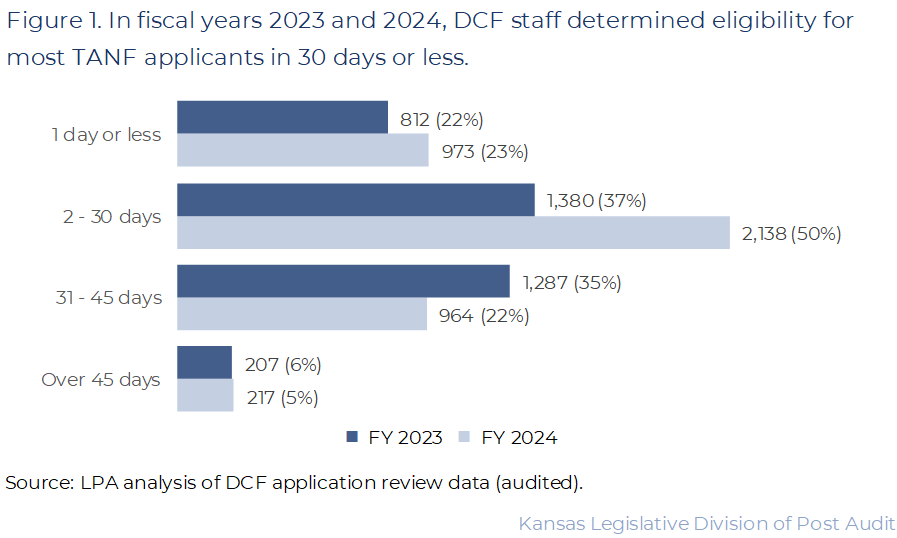
It took DCF an average of 22 days to approve or deny TANF applications in fiscal years 2023 and 2024, but staff reported only spending about 1 hour actively verifying applications.
- Our audit objective asked us to evaluate how long it takes DCF to verify a TANF application. However, the state does not have a single TANF application. Rather, it uses a joint application for TANF, SNAP, and childcare assistance. There is significant overlap in the information necessary to apply for each program. Given the overlap, we think it’s still reasonable to evaluate how long it takes to verify the joint application.
- DCF provided us with data from federal fiscal years 2023 and 2024 showing when the application was submitted (or received in the case of paper applications) and when DCF made an eligibility determination. However, this data included gaps in time when staff weren’t actively working on the TANF application. This happens because sometimes staff must wait on documentation from the applicant or from other agencies. As a result, that down time is included in our analysis. We supplemented our work by interviewing DCF staff for their opinions on how much time they actively spent processing each case. As a result, our analysis estimates how long DCF staff spent actively processing a case, as well as the total time elapsed from submission to determination.
- Across the 2 years we reviewed, the time from application submission to eligibility determination was an average of 22 days. There was a slight improvement in average time from 25 days in 2023 to 21 days in 2024. Figure 1 shows the percentage of applications DCF reviewed by length of time. As the figure shows, DCF reviewed most applications in less than 30 days during those 2 years. On average, there were about 4,000 TANF applications each year.
- DCF officials told us it typically takes a total of 60-80 minutes of active work to verify eligibility. Factors such as the amount of information that needs to be verified (e.g. number of household members or various types of income) can influence how much time it takes. The time it takes to process an application can also vary depending on how the application is received, whether additional documentation is needed, and other factors.
- Both the amount of time staff spend actively processing the application and the time spent waiting on documentation are important variables in total processing time. Active time reflects the time it takes to review the application and to verify required or inconsistent information. The time staff spend waiting reflects the time it takes for applicants to submit information or time it takes to receive information from other agencies. Both ultimately contribute to the overall timeliness of processing applications. The staff who process TANF applications also review SNAP and childcare assistance applications. These additional responsibilities fill potential staff down time waiting for applicants and other agencies to provide requested TANF information.
Although our analysis was limited, we estimated it took the applicants we reviewed an average of about 1 hour to complete an online application for TANF benefits in fiscal year 2025.
A few factors limited our analysis of the TANF application process.
- Our audit objective asked us to evaluate how long it takes applicants to complete a TANF application. However, the state does not have a single TANF application. Rather, it uses a joint application for TANF, SNAP, and childcare assistance. For that reason, our estimates include the time it took to complete an application for all 3 programs, rather than just the TANF program.
- We could only evaluate the amount of time it took applicants to complete an online application. About half of all applications are submitted on paper each year. DCF does not have any data on how long it takes applicants to complete an application when it is submitted on paper so we could not evaluate these applications. In federal fiscal year 2025, we estimated about 4,000 total applications were submitted. We could only evaluate the nearly 2,100 applications completed online.
- DCF collects data on the total time it took applicants to submit the application. The total time includes any downtime created when applicants pause the completion of their applications. The total time it takes a person to submit the application isn’t an accurate depiction of the active time they spent working on it. It’s likely that many applicants began an application, paused it, and resumed completing it at a later time. For example, it’s unlikely an applicant needs weeks to answer questions about the number of people living in their household. It’s more likely that life circumstances (e.g., work, family, or other responsibilities) cause applicants to pause their application and resume it later.
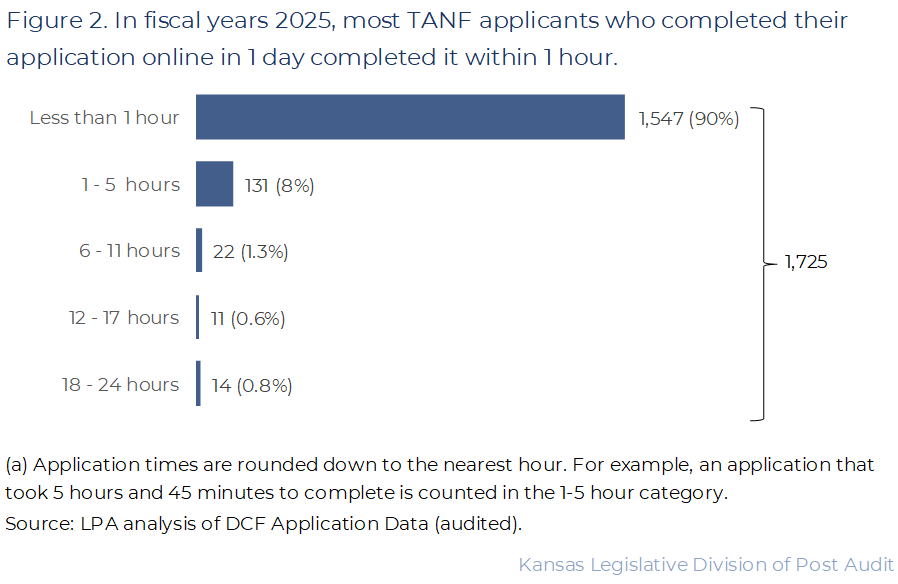
- We took steps to help mitigate this issue. That included narrowing down applications to just those that were completed within a 24-hour window. We think this is a reasonable proxy for applications that were completed in one sitting. In total, 81% (1,725) of all applications submitted online in fiscal year 2025 were completed in 24 hours.
On average, we estimated it took applicants who completed an online application in one sitting about 1 hour to complete a TANF application in fiscal year 2025.
- For all 2,124 applicants who submitted an online application in fiscal year 2025, the average time from start to submission was 6 days. However, this reflects the total amount of time from when the applicant began the application to when they submitted it. It may not reflect how much time they spent actively working on it.
- We limited our evaluation to 1,725 applicants who started and submitted their application in 1 day to better approximate the active time applicants spent. Ultimately, we estimated this accounts for about half of all TANF applications submitted in fiscal year 2025. We cannot project these results to the whole population of applicants. This is because we do not know if the amount of time it takes to apply on paper is significantly different from the amount of time it takes to apply online. We evaluated those who started and submitted their application in one day because these individuals likely completed their application in 1 sitting. As such, they may provide the best sense for how long it takes to complete the application when completing it without long interruptions.
- For those applicants who completed their application in 1 day, Figure 2 shows how many hours applicants spent applying. As the figure shows, 90% (1,547) of the 1,725 applicants that completed an application in 1 day, completed the application in less than 1 hour.
Stakeholders we talked to estimated it takes 15 minutes to 2 hours for individuals to complete the application.
- Because our analysis was limited, we also spoke to 4 organizations in Kansas who provide assistance to individuals applying for TANF or SNAP benefits. Each organization helps an individual fill out the application either on paper or online. In some cases, the organization will provide transportation to a DCF office or deliver the application to DCF on behalf of the applicant. The 4 organizations we spoke to were:
- Harvesters – Lawrence
- Refuge in the Storm (RISE) – El Dorado
- Strengthening and Empowering Neighborhoods Together (SENT) – Topeka
- East Central Kansas Economic Opportunity Corporation – Ottawa
- We asked each organization to estimate the amount of time it typically takes to complete an application. We did not specify whether the application was completed online or on paper. Most provided a range based on various factors such as whether the applicant has easy access to technology or documentation. They estimated it takes 15 minutes to 2 hours for individuals to complete the application.
- All 4 organizations told us that the applicant’s mental health or disabilities can pose barriers to completing the application in a timely manner. For example, 1 organization told us they often sit with individuals to help them complete the application. If the applicant does not have mental health challenges or other barriers it can be a quick process. However, for those who have difficulty focusing or understanding the questions it may take hours to complete the application.
- Stakeholder estimates are similar to what 5 other states estimated it takes for applicants to complete a TANF application. These states included average completion times as part of their application forms. We reviewed those estimates but did not verify that the estimates they provided were accurate. We chose these 5 states because they also had applications that included TANF and multiple other programs.
- Colorado: 30-90 minutes
- Florida: 30-60 minutes
- Missouri: 40 minutes
- Nebraska: 20-30 minutes
- Washington: 60 minutes
Stakeholders and researchers have noted several barriers TANF applicants face in completing an application.
- We asked the same 4 local organizations about other challenges individuals face when applying for assistance. All 4 organizations mentioned a few of the same difficulties:
- The application is difficult to understand. Organizations reported they often must explain what certain questions mean or help applicants navigate through the application as a whole. For example, 1 organization reported that some people may have difficulty reading which makes it challenging for them to complete the application.
- It’s not always clear what documents need to be submitted. Some organizations noted that applicants sometimes need help understanding what documents are acceptable. Others mentioned it can be difficult for some applicants to obtain the necessary documents. For example, 1 organization noted that it can be problematic for some applicants to get documents related to their children if they have a difficult relationship with the other parent.
- Completing an application online can be challenging. Many applicants do not have computers or internet access at home. As a result, they may need to complete the application on their phone where it is more difficult to read. Additionally, applicants sometimes do not remember their login credentials and have difficulty accessing the application portal.
- We also reviewed a couple studies that examined difficulties in accessing assistance programs. The studies we reviewed noted some issues:
- A 2023 study published by the Russell Sage Foundation found that Kansas was among the states with the highest TANF administrative burden on the applicant. An administrative burden is the cumulative effects an applicant may experience to learn about a new program, understand whether they are eligible, and comply with the rules the program imposes. The study noted that the higher the burden, the fewer the families that received TANF benefits.
- A 2021 study published by the Urban Institute found that TANF ranked worse in comparison to other assistance programs for enrollment challenges. The study compared TANF to other assistance programs such as unemployment, SNAP, and Medicaid. The challenges noted included negative interactions with program staff and complex eligibility and documentation requirements.
- Last, reading comprehension challenges may also make completing an application difficult. According to the National Literacy Institute, half of adult Americans read below a 6th grade level. We used 3 readability indices to determine what grade level the TANF application is written at. Based on that work, we found the TANF application is written at about a 7th grade reading level. This may pose some challenges to TANF applicants’ ability to adequately comprehend the application. It may also lead the applicant to provide inaccurate information if they did not truly understand the question.
We identified about $23,000 in TANF ATM transactions at questionable locations such as casinos and liquor stores in fiscal years 2023 and 2024.
Federal and state law require DCF to take several steps to identify and prevent fraud and other misuse in the TANF program.
- Federal law requires DCF to take steps to identify and prevent fraud and misuse in the TANF program. Those steps include:
- The department is required to submit a state plan to the U.S. Department of Health and Human Services. The plan must include a certification by the governor that Kansas has established and is enforcing procedures that protect TANF from fraud and abuse.
- DCF is required to submit a Work Verification Plan that includes procedures on how the department will verify that certain applicant data is accurate.
- DCF must annually report what their policies are to prevent TANF benefits from being used at improper locations (e.g. liquor stores or casinos).
- DCF must also have policies that prevent EBT cards from being used in various locations such as liquor stores and casinos.
- State law also requires DCF to take a few actions.
- DCF is required to monitor replacement EBT card requests. When a beneficiary requests their fourth replacement card in a 12-month period, DCF must notify the beneficiary that their next request will trigger a fraud investigation.
- DCF must establish a system for individuals to report suspected fraud, waste, or abuse.
- DCF must offer to place the recipient’s picture on their EBT card.
- DCF has also implemented additional policies to prevent fraud and other misuse. For example, the department allows recipients to temporarily turn off their EBT card from their online account if they lose their card. Further, if DCF suspects theft of an EBT card, it requires the recipient to reset their PIN. Additionally, DCF has 2 staff members who routinely monitor EBT transactions for potential fraud or misuse.
Generally, DCF appeared to comply with the requirements we reviewed but we identified 1 state law DCF has not implemented.
- We reviewed DCF documents and interviewed DCF staff to understand what steps DCF has implemented to prevent and detect fraud in the TANF program. We compared DCF’s actions to 7 federal and state requirements for detecting and preventing fraud to determine if the department complied with those laws.
- Figure 3 shows the federal and state requirements we reviewed. As the figure shows, DCF complied with most of the state and federal laws we reviewed. For example, DCF has implemented a toll-free hotline for individuals to report fraud or abuse in the TANF program. They have also submitted a state plan to the U.S. Department of Health and Human Services and have policies that require they monitor replacement EBT card requests.
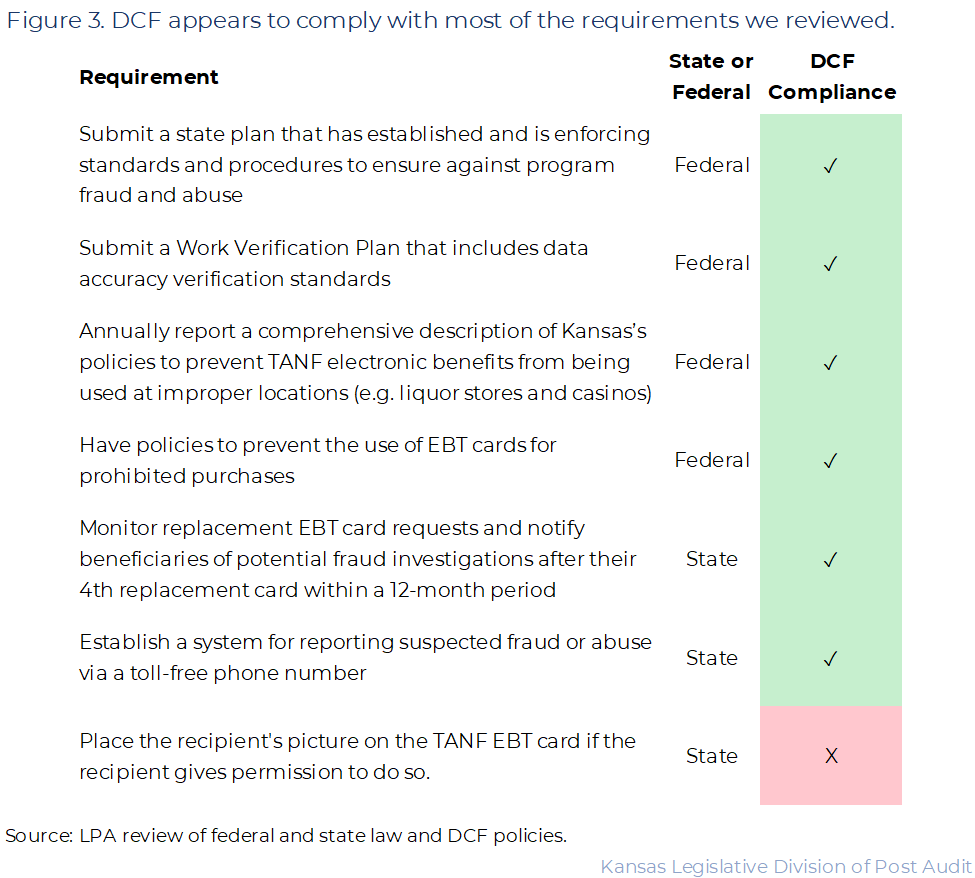
- However, DCF does not offer to place recipient photos on EBT cards. K.S.A. 39-709 (15)(A) requires DCF to place a photo of the recipient on the EBT card if the recipient approves. However, DCF currently does not offer this. The purpose of the photo is to deter and identify EBT card theft. Without a photo ID, card theft may be harder to detect. Although we asked, department officials did not provide us with a reason for why they have not implemented this law.
We reviewed TANF transactions across 2 years to identify patterns that might indicate misuse.
- We were able to review TANF EBT transaction-level data for federal fiscal years 2023 and 2024. DCF provided the data containing nearly 660,000 TANF transactions. It contained information such as the card number that made the transaction, where the transaction occurred, and how much the transaction was for.
- We looked for suspicious patterns in how recipients used their TANF EBT cards to identify potential misuse. Our work to identify these issues is described below:
- Withdrawing cash at impermissible locations: Recipients can use their EBT cards to get cash from ATMs. However, TANF recipients are prohibited from using their cash assistance at certain locations (e.g. liquor stores, casinos, tattoo parlors, etc.). Although we could not determine how recipients used TANF cash, we could see if they withdrew cash from ATMs at impermissible locations. We found some questionable ATM transactions. Details about this finding are in the following section of the report.
- Stolen cards: We looked for suspicious patterns in how and when cards were used. For example, we evaluated whether multiple cards were used in proximity to one another. Multiple cards being used consecutively at the same location at the same time could indicate stolen cards. We found a few instances of this which we also discuss in the following report section.
- Selling cards: Unlike SNAP, there is little incentive for cash-for-card schemes. This is because recipients can withdraw cash directly from an ATM. Tests that look for things like unusual purchasing times, locations or amounts are not helpful for TANF because this type of scheme is unlikely. As a result, we did not perform those tests on this data.
- We reviewed all transactions made between October 1, 2022 through September 30, 2024. This included purchases made at retail stores and cash withdrawals made at ATMs. We searched the data using key words such as “casino”, “liquor”, and “cigarettes” to find transactions that occurred in those places. We chose those key words because they are associated with items that TANF recipients are prohibited from buying with the TANF EBT card or TANF cash. Additionally, it is not uncommon for certain businesses (like casinos and liquor stores) to have ATMs in or near their business.
We identified transactions at impermissible locations totaling about $23,000 in fiscal years 2023 and 2024, but this number is likely understated.
- Per federal and state law, TANF recipients are prohibited from using their TANF cash assistance at a variety of locations. This includes liquor stores, casinos, tattoo parlors, spas, and movie theaters.
- We found 122 EBT cards (out of a total of 11,703 active cards) that successfully completed 227 ATM transactions at Kansas locations associated with alcohol, casinos, tobacco, racing, and tattoo parlors. The total amount of those transactions was about $23,000. These transactions indicate that a recipient used their TANF EBT card to get cash at an ATM at those locations.
- On average, each identified recipient withdrew about $190 in TANF cash assistance at ATMs associated with impermissible locations.
- A few recipients withdrew over $750 in cash assistance at ATMs. For example, 1 recipient withdrew nearly $1,800 across 6 transactions in 4 months at a casino. Another withdrew $870 across 12 transactions in 6 months at ATMs at casinos.
- We also found smaller ATM withdrawals from ATMs located at liquor stores, racetracks, and tattoo parlors.
- DCF has policies to prevent EBT cards from being used at impermissible locations and for impermissible items. For example, an EBT card will automatically reject paying for prohibited items (such as cigarettes). However, the department has difficulty in identifying all possible ATMs in impermissible locations. DCF officials told us they are not always aware of the type of retailer where an ATM is located. When they know the ATM is at an impermissible location, they can prevent the use of the EBT card at that location. They also told us that some ATMs are movable. In some cases, an ATM may be at a location that is not prohibited but may later be moved to a prohibited location. They are often not aware of the movement.
- There are a couple caveats on this work. First, our work only shows that a recipient accessed an ATM machine at these locations. We do not know where they spent the money they withdrew. Second, we used a keyword search that likely left some impermissible retailers undiscovered. Retailer names do not always reveal specifically what the store is. For example, a retailer called “Jack’s” could be a liquor store, but the name does not make that clear. Without an obvious keyword (e.g., liquor or wine) our analysis would not be able to identify “Jack’s” as a liquor store. As a result, we have likely understated the amount of transactions at impermissible locations because a keyword search could not identify them.
- We also identified some other suspicious activity, but we did not have enough evidence to determine whether it was misuse. We found about 30 cards held by recipients who appear to be unrelated but were consistently used at the same time. This could indicate the theft of a card. However, there are legitimate reasons this could occur such as individuals who live together and often do their shopping together. It was not possible for us to verify the legitimacy of these transactions. However, we sent the EBT card numbers for the transactions we flagged to DCF officials for them to review and determine the appropriate action.
Conclusion
It’s somewhat unclear how long it takes to complete or verify an application. Generally, it appeared to take applicants about 1 hour to complete an online application. Further, DCF staff estimate it takes them about an hour to process the application. However, our analysis of both these time frames comes with multiple caveats because of data limitations.
Additionally, it appears that some recipients might be using their TANF benefits at prohibited locations (e.g. liquor stores, casinos, and tattoo parlors). This is because the TANF program allows recipients to withdraw cash from ATMs. This allows recipients to bypass the point-of-sale controls DCF has in place to block prohibited purchases.
Recommendations
- To comply with state law, DCF should offer to place recipient photographs on TANF EBT cards.
- Agency Response: Without a fiscal appropriation by the legislature to pay for the reissuance of all current (and future) EBT cards with a photo of a household member, the agency cannot begin taking steps to plan for implementation of the recommendation.
- DCF should follow up on the questionable transactions we identified and sent to them.
- Agency Response: DCF has already completed this recommendation. DCF reviewed the transactions noted by LPA as questionable. After reviewing the cash transactions at questionable locations, DCF added those locations to the TANF cash block list to prevent future cash transactions at those locations.
Agency Response
On March 17, 2026 we provided the draft audit report to DCF. Agency officials generally agreed with our findings and conclusions, but noted some issues in implementing 1 of the recommendations.
- The agency noted some complications with complying with the state law that requires DCF to offer to place recipients photographs on their EBT cards. Specifically, they noted there are situations where the person using the EBT card may not be the person whose photo is on the card. For example, any household member may use the EBT card so the photo may not match the person using the card. Additionally, if a recipient is disabled a caretaker may be using the card. In this case the photo would not match the person using it. DCF officials noted this may impose burdens to using the EBT card if retailers notice the picture on the card does not match the person using the card. DCF also raised issues with the feasibility of requiring all recipients to come to an office to take a picture and the cost of implementing the recommendation.
- Although LPA understands these issues, state law only requires DCF to place a photo of the recipient on the EBT card if the recipient agrees. If the recipient finds this to be a hardship they can decline. Further, state law allows the photo of a guardian to be placed on the card if the recipient is a minor or is incapacitated. If DCF determines that offering to place a picture on the EBT card is not feasible, they should work with the legislature to change the law.
DCF Response
Thank you for the opportunity to provide a response to the Performance Audit Report: Reviewing Temporary Assistance for Needy Families (TANF)’ Eligibility Processes and Spending. We appreciated the professional conduct of the LPA staff during the course of the review. The Kansas Department for Children and Families (DCF) respectfully submit the following responses for the audit findings listed below.
To comply with state law, DCF should offer to place recipient photographs on TANF EBT cards.
Benefits for the Supplemental Nutrition Assistance Program, Child Care Assistance, and Temporary Assistance for Needy Families are issued on the same Electronic Benefit Transfer (EBT) card. This would mean that the Supplemental Nutrition Assistance Program (SNAP) federal requirements and logistical concerns would apply (see below).
- For example, in FFY2025, approximately 79% of TANF households also received SNAP benefits.
Due to this overlapping of program benefits being loaded onto the same cards, all cards would need to be replaced with a photo ID. Under the current EBT contract, the cost for each card with no photo is $0.20 and the cost for each EBT card with a photo is $2.65. Based on January 2026 data, the additional cost for implementation, equipment, and training/education for cardholders, staff, and retailers if the agency were to offer the photo ID is as follows:
- 97,370 active EBT cards for 88,565 households.
- At this participation rate, the cost to renew all cards to include photo ID would be approximately $258,030.
- An increase in the amount of SNAP would require an increase in SGF by approximately $111,882.
- The current funding mix for EBT card costs in FY26 includes
- SGF (43.36%),
- Federal SNAP Admin (43.36%),
- Federal TANF (1.19%); and
- Federal CCDF (12.09%).
Without a fiscal appropriation by the legislature to pay for the reissuance of all current (and future) EBT cards with a photo of a household member, the agency cannot begin taking steps to plan for implementation of the recommended finding.
The following SNAP federal regulations and logistical concerns regarding Photo ID’s on EBT cards include:
- Federal regulation of issuing one card per household.
- As a number of people in the household are authorized to use the EBT card, the state must determine whose photo would be required, how individuals will be informed of their right to use the card, and how retailers are to ensure that all authorized individuals may do so.
- Federal regulations enable a SNAP household to designate an “authorized representative” not in the household.
- Many SNAP participants who are unable to get to the store due to physical condition or who require help in managing their finances due to mental impairment often rely upon authorized representatives to buy food for them. Photo EBT card requirements make it harder for friends, family members, and volunteers to assist individuals with severe needs.
- Additionally, individuals with disabilities may not be able to go to the office themselves to provide a photo. There need not be a determination of disability to appoint an authorized representative. Guardrails are in place so that the SNAP household can limit the role of that representative (for example, to assist with food purchase only), and the state agency typically issues a separate EBT card for the authorized case head or local organization providing regular food shopping assistance to the recipient, such as a group home or an organization with personal care attendants (staff which may vary from month to month).
- Logistical concerns include requiring the inspections of the photo. 7 CFR 274.7(f) requires equal treatment of SNAP households by retailers and vendors. The rights of SNAP clients to access their benefits are seemingly placed at risk if retailers are asked to impose burdens on their checkout employees to inspect the photo EBT card.
DCF should follow up on the questionable transactions we identified and sent to them.
DCF has already completed this recommendation. DCF reviewed the transactions noted by LPA as questionable. After reviewing the cash transactions at questionable locations, DCF added those locations to the TANF cash block list to prevent future cash transactions at those locations.
In conclusion, we thank the Legislative Post Audit team for the opportunity to discuss the Performance Audit Report: Reviewing Temporary Assistance for Needy Families’ Eligibility Processes and Spending. As stated in the report’s conclusion, TANF cash assistance is somewhat different from other benefit programs in terms of how the federal government monitors it. Unlike SNAP or Medicaid, the federal government does little to monitor the accuracy of states’ TANF eligibility determinations or the accuracy of their payment amounts. Additionally, it’s somewhat unclear how long it takes to complete or verify an application. Generally, it appeared to take applicants about one hour to complete an online application. Further, DCF staff estimate it takes them about an hour to process the application.
We thank you again for the opportunity to provide clarification and response.
Sincerely,
Laura Howard,
Secretary
Patrick Roche,
Audit Services Director
Appendix A – Cited References
This appendix lists the major publications we relied on for this report.
- Erroneous Payment Initiative (March, 2009). Health and Human Services Office of Inspector General.
- Temporary Assistance for Needy Families: Actions Needed to Improve HHS Oversight (April, 2025). U.S. Government Accountability Office.
- Administrative Burdens and Economic Insecurity Among Black, Latino, and White Families (2023). Russell Sage Foundation Journal of the Social Sciences.
- Customer Service Experiences and Enrollment Difficulties Vary Widely across Safety Net program (January, 2023). Urban Institute.