Evaluating the State Fire Marshal’s Inspection Requirements
Introduction
Senator Chase Blasi requested this audit, which was authorized by the Legislative Post Audit Committee at its June 6, 2025 meeting.
Objectives, Scope, & Methodology
Our audit objective was to answer the following questions:
- Did the Kansas State Fire Marshal’s Office (KSFM) conduct consistent and adequately supported inspections of residential and childcare facilities?
- How does the Kansas State Fire Marshal’s process for conducting inspections of residential and childcare facilities compare to the inspection processes used by Kansas’s local jurisdictions?
For the first question, the audit proposal originally asked us to evaluate whether KSFM’s inspections of residential and childcare facilities aligned with regulatory requirements. However, regulations do not specify how KSFM should conduct or document fire safety inspections. Therefore, we modified the first question to reflect the work we could do and that aligned with the intent of the initial request. The scope of our work for the first question included reviewing a judgmental selection of KSFM’s fire safety inspections of residential and childcare facilities in calendar years 2024 and 2025. We didn’t review KSFM’s inspections of other types of facilities. Our method included reviewing documentation of selected inspections KSFM did. It also included accompanying KSFM inspectors in early 2026. As part of this, we interviewed representatives of facilities KSFM inspected and other stakeholders. We also compared KSFM’s inspection control designs to best practices.
For the second audit question, the scope of our work included comparing KSFM’s inspection processes to the inspection processes that 3 judgmentally selected local jurisdictions described. Our method included interviewing representatives of the local jurisdictions about how they inspect facilities. We compared the processes they described to us to what KSFM does but did not observe actual inspections those local jurisdictions conducted.
This audit did not require us to evaluate whether KSFM did all inspections it should have. Therefore, we didn’t do things like review data to determine whether KSFM did timely or required inspections.
More specific details about the scope of our work and the methods we used are included throughout the report as appropriate.
Important Disclosures
We conducted this performance audit in accordance with generally accepted government auditing standards. Those standards require that we plan and perform the audit to obtain sufficient, appropriate evidence to provide a reasonable basis for our findings and conclusions based on our audit objectives. We believe that the evidence obtained provides a reasonable basis for our findings and conclusions based on our audit objectives.
Audit standards require us to report our work on internal controls relevant to our audit objectives. They also require us to report deficiencies we identified through this work. In this audit, we evaluated the agency’s internal controls related to its fire safety inspections. We noted that weak inspection controls created risks of inconsistent or inadequate inspections. The controls we reviewed and the results of that work are described in more detail later in this report. Our audit reports and podcasts are available on our website www.kslpa.gov.
KSFM inspectors didn’t always do consistent inspections and didn’t always adequately support the violations they cited for the selected inspections we reviewed from 2024 to 2026.
Background
The Kansas State Fire Marshal’s Office is responsible for protecting people and property from fire hazards.
- The Kansas State Fire Marshal’s Office (KSFM) was created in 1913. The agency head is appointed by the governor and confirmed by the Senate.
- KSFM has a variety of responsibilities under state law. It’s responsible for adopting and enforcing fire safety regulations. It’s also responsible for investigating fires and explosions and for keeping records of fires in Kansas. This audit focuses on KSFM’s enforcement of fire safety regulations.
- KSFM has 5 divisions: prevention, emergency response, investigations, administration, and industrial safety. This audit focuses on KSFM’s prevention division. The prevention division does fire safety inspections to check compliance with regulations.
- KSFM has about 75 total staff. The prevention division has about 34 staff, of which about 20 do fire safety inspections. These inspectors cover 14 different parts of the state. For example, 1 inspector covers 17 counties in northwest Kansas. Another inspector covers 8 counties in southeast Kansas.
State law requires KSFM to adopt regulations to promote fire safety.
- State law (K.S.A. 31-133) directs KSFM to adopt rules and regulations to guard against fire hazards. As part of this, state law allows KSFM to adopt specific editions of nationally recognized fire prevention codes.
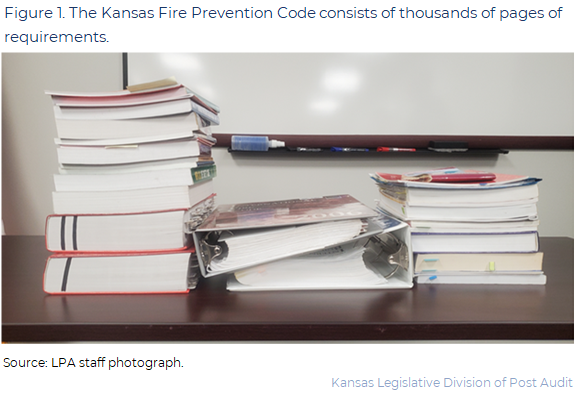
- In 2011, KSFM adopted several nationally recognized standards in K.A.R. 22-1-3. They include the 2006 editions of the International Code Council’s International Building Code and International Fire Code (IFC) and the 2006 edition of the National Fire Protection Association’s (NFPA) Life Safety Code. KSFM also adopted about 20 other standards NFPA published between 2002 and 2008. As Figure 1 shows, these standards include thousands of pages of guidance and requirements. Together, these standards comprise the Kansas Fire Prevention Code.
- The fire prevention code applies to most facilities. It applies to all buildings, such as grocery stores, restaurants, residential and childcare facilities, and apartment complexes. However, it doesn’t apply to one- or two-family homes. Facilities must follow applicable requirements from all standards KSFM has adopted as part of the code. However, not all requirements apply to all types of facilities.
- The code also has uniform force and effect throughout the state. This means local governments can’t exempt themselves from the state fire prevention code (e.g., through home rule privilege). However, local governments can adopt requirements that are more stringent than the standards KSFM adopted in the state’s fire prevention code.
- The code includes requirements related to preventing and protecting against fires. The requirements lay out how buildings should be designed and maintained. They also identify what kinds of fire protection systems facilities should have and maintain, such as sprinklers and fire extinguishers. Requirements also cover issues related to occupant safety. For example, they require periodic fire drills and clear paths to building exits.
- State law (K.S.A. 31-139) allows KSFM to enter and inspect buildings for compliance with the Kansas fire prevention code. It requires them (or in some cases, local fire departments) to inspect certain buildings annually such as schools (K.S.A. 31-144). But it doesn’t require KSFM to inspect all buildings annually.
This audit focuses on fire safety inspections of residential and childcare facilities.
- Residential facilities provide long-term housing for individuals who need personal care or nursing services. The Department for Aging and Disability Services (KDADS) licenses and oversees these facilities. They encompass:
- Nursing homes operate 24 hours per day and provide housing and nursing care. Nursing homes that accept Medicare or Medicaid funding are subject to the federal Centers for Medicare and Medicaid Services (CMS) requirements.
- Large residential board and care facilities provide lodging and boarding for 17 or more individuals. These facilities provide personal care services to residents (e.g. assisted living facilities).
- Small residential board and care facilities provide lodging and boarding for between 4 and 16 individuals. These facilities provide personal care services to residents (e.g. home plus facilities). KSFM officials told us they don’t inspect homes that serve fewer than 4 individuals.
- Childcare facilities provide care to children under age 16 from someone who isn’t their parent or guardian. The Department of Health and Environment (KDHE) licenses and oversees these facilities. They include:
- Childcare centers provide care for children in commercial (i.e., nonresidential) settings. They provide care for between 3 and 24 hours per day.
- Home daycares provide care for no more than 12 children in one- and two-family homes.
- Preschools provide care for children at least 3 years of age for no more than 3 hours per day per child.
KSFM inspects residential and childcare facilities for varying purposes and according to different standards.
- KSFM does several types of inspections of residential and childcare facilities. Figure 2 summarizes the inspections they do. As the figure shows, KSFM does 3 kinds of inspections of each facility.
- These include:
- Routine inspections. KSFM does these inspections annually for licensure purposes to ensure residential and childcare facilities are complying with fire safety requirements. Home daycares are the exception. KSFM only inspects home daycares once so they can get their initial licenses.
- Complaint-based inspections. KSFM will inspect residential and childcare facilities when it receives complaints about them. In a complaint-based inspection, KSFM will only inspect areas of the facility discussed in the complaint.
- Compliance inspections. KSFM may do compliance inspections of residential and childcare facilities to determine whether they corrected problems from prior inspections. KSFM officials told us they only do these inspections if facilities have significant problems and the facilities don’t communicate with KSFM about their correction plans.
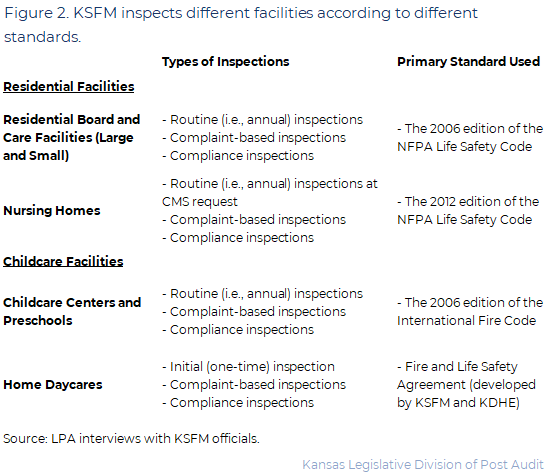
- KSFM inspects residential and childcare facilities based on different standards. As Figure 2 shows:
- KSFM inspects residential board and care facilities for compliance with the 2006 edition of the NFPA Life Safety Code. This is one of the standards KSFM adopted as part of the Kansas fire prevention code.
- KSFM inspects nursing homes for compliance with the 2012 edition of the NFPA Life Safety Code. That’s a more recent edition of the Life Safety Code. KSFM hasn’t adopted this edition as part of its rules and regulations. But it’s the standard CMS requires nursing homes to follow to participate in Medicare and Medicaid. This means KSFM inspectors must inspect nursing homes for compliance with a different edition of the NFPA Life Safety Code – one that KSFM doesn’t use for inspections of other residential facilities.
- KSFM inspects childcare centers and preschools for compliance with the 2006 edition of the International Fire Code. This is one of the standards KSFM adopted as part of the Kansas fire prevention code.
- KSFM inspects home day cares for compliance with a fire and life safety agreement. The agreement consists of a handful of requirements KSFM and KDHE agreed on for home day cares. KSFM doesn’t inspect home daycares for compliance with any national standards. KSFM officials said this was because KSFM doesn’t have regulatory authority over the one- or two-family homes these daycares typically operate out of.
- KSFM also does construction-related inspections of these facilities, but we didn’t review those inspections in this audit. These inspections generally ensure buildings meet applicable construction requirements.
KSFM conducted routine inspections of almost 2,700 residential facilities and 4,600 childcare facilities between 2022 and 2025.
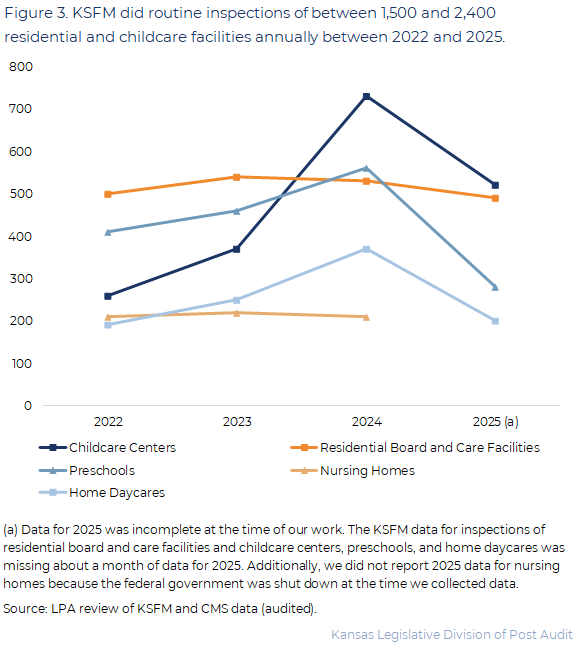
- We reviewed KSFM data to determine how many routine inspections KSFM did of residential board and care and childcare facilities. We also reviewed CMS data to determine how many nursing homes KSFM inspected. We reviewed data from calendar years 2022 through 2025. We reported rounded numbers because the data appeared to have minor incompleteness issues. We obtained the data in November and December 2025. So, the KSFM data for 2025 was missing about a month of data. We also noticed the KSFM data for other months was missing a small percentage of inspections. However, we didn’t think there were enough missing inspections to significantly affect our conclusions about the number of inspections KSFM did.
- Figure 3 shows how many routine inspections KSFM did between 2022 and 2025. As the figure shows, the number of residential facility inspections was relatively stable over the period we reviewed. However, the number of childcare facility inspections fluctuated. KSFM inspected more childcare facilities in 2024 than in prior years because KSFM stopped allowing local fire departments to inspect them. This is discussed in more detail in question 2. KSFM officials also told us the state offered grants to open or expand childcare facilities in 2024, and that also caused KSFM to do more childcare facility inspections. On average, KSFM conducted about 700 routine inspections of residential facilities and around 800-1,700 routine inspections of childcare facilities annually from 2022 to 2025.
- We can’t say how many inspections local jurisdictions did of residential or childcare facilities. We would have had to collect data from each local jurisdiction to determine that. That work was outside the scope of this audit. We discuss the work we did with 3 local jurisdictions as part of the second audit question.
KSFM has a similar process for routine inspections of residential and childcare facilities.
- A routine inspection of either facility has 2 main parts: a document review and a physical inspection.
- Inspectors do document reviews to determine whether facilities maintained required systems. Inspectors review records and paperwork to determine whether facilities got service for things like fire alarms and sprinklers. Inspectors also review whether facilities did regular fire drills and other routine checks.
- During physical inspections, inspectors walk around facilities. They do this to check whether facilities meet applicable standards. For example, inspectors will check things like whether the facility has emergency lighting and clean sprinklers.
- KSFM inspectors record their observations in an application called OneNote. OneNote is a notetaking application inspectors use on their phones. KSFM gives inspectors a template to record their document reviews. Inspectors then record notes about observations from the physical inspections. As part of this, inspectors may include photographs of violations.
- At the end of inspections, KSFM inspectors discuss their observations with facility officials.
- After an inspection, inspectors record results in KSFM’s database system, Firehouse. Inspectors record the violations they noticed. As part of this, inspectors should support violations with references to applicable standards. For example, section 1003.6 of the 2006 IFC requires exit paths not to be obstructed. So, if an inspector found a childcare facility had an obstructed exit, the violation report should include a reference to that section.
- Firehouse then generates a report identifying all the violations the inspector found. Appendix B shows what a violation report looks like. The inspector sends a copy of the report to the facility. The violation report KSFM sends to CMS facilities is different from the report it sends to other facilities. But both reports outline the violations inspectors found. They also include the references that support the violations.
- A facility has 10 days after it receives a violation report to submit a corrective action plan. The plan outlines what the facility will do to correct the violations. KSFM staff review facilities’ plans for appropriateness. If KSFM finds a facility’s plan is appropriate, it will issue an acceptance letter. A facility then has an additional 80 days (90 days total) to make the corrections. However, a CMS facility only has an additional 20 days (30 days total) to make corrections. KSFM may require proof of corrections (such as photographs). Or it may wait until the next routine inspection to check whether the facility corrected problems. KSFM officials told us they don’t assess financial penalties for noncompliance.
Other organizations also inspect residential and childcare facilities.
- Other state and federal agencies inspect residential and childcare facilities, too. Some of the inspections are related to fire safety, but others are not. This can result in facilities being inspected by multiple agencies during the year, each using different requirements. For example:
- KDADS and KDHE should inspect facilities about annually for compliance with health and safety requirements. KDADS inspects residential facilities and KDHE inspects childcare facilities. The requirements KDADS and KDHE use for their inspections are different than the ones KSFM uses.
- State law also allows local jurisdictions to inspect residential and childcare facilities for compliance with state fire safety requirements on behalf of KSFM. However, they may also inspect them for compliance with local fire safety requirements. Local fire safety requirements may be different than state fire safety requirements as described in question 2.
- CMS sometimes inspects nursing homes after KSFM inspects them. CMS does this to monitor KSFM’s inspections. CMS requirements are different than state fire safety requirements.
- It’s both differences across agencies and within KSFM inspections that led to this audit. Facilities reported to the legislature that they get conflicting guidance through different inspections and that they’re held to conflicting standards. They said this forces them to choose what guidance they’ll follow and may cause them to make expensive and sometimes unnecessary fixes.
- We only reviewed inspections related to fire safety in this audit. We didn’t review KDADS or KDHE inspections. This means we can’t say whether KSFM’s expectations conflict with those agencies’ expectations. But we reviewed information about the inspections KSFM, CMS, and local jurisdictions do. We discuss differences between KSFM and local expectations in question 2.
Methodology
This audit evaluated whether KSFM’s inspections were consistent and adequately supported.
- The purpose of this audit was to evaluate whether KSFM did consistent and adequately supported inspections of residential and childcare facilities.
- For an inspection to be consistent, it should be done in the same way as other inspections. We expected inspections to be consistent in 3 ways. First, inspectors should check for compliance with the same requirements. Second, inspectors should check for compliance with requirements in the same way. And third, inspectors should consistently identify and cite facilities for violations.
- For an inspection to be adequately supported, it should check a facility for compliance with applicable requirements. We expected inspectors to cite facilities only for violations of applicable requirements. Inspectors also should support citations with clear and accurate references to requirements.
- We didn’t evaluate other aspects of KSFM’s inspections. For example, we didn’t evaluate whether inspectors checked for compliance with everything they should have. We also didn’t evaluate whether inspectors checked for compliance in the right ways. That’s because the requirements in state fire code are voluminous and technical and we don’t have the expertise or training to make those kinds of determinations.
We reviewed a selection of KSFM’s inspections from 2024 to 2026 to determine whether they were consistent and adequately supported.
- We reviewed 26 inspections KSFM did between January 2024 and January 2026 to evaluate whether they were consistent and adequately supported. We picked this time frame because it covers the administration of the current state fire marshal. We selected the inspections based on concerns stakeholders reported and the facilities’ proximity to Topeka. For example, we focused on facilities stakeholders told us they had concerns about.
- We accompanied inspectors for 10 inspections done by 5 different inspectors in January 2026. 5 inspections were of residential board and care facilities and 5 were of childcare centers. Each inspector did 1 inspection of each facility.
- We reviewed documentation from 16 other inspections KSFM did in 2024 and 2025. 3 inspections were of residential board and care facilities. 6 inspections were of childcare facilities. And 7 inspections were of nursing homes. We also reviewed follow-up inspections CMS did of 4 of the 7 nursing home inspections KSFM did.
- The results of our documentation and observation reviews aren’t projectable to KSFM’s inspections of all residential and childcare facilities. That’s because we judgmentally selected the inspections we reviewed. Further, our selected inspections represented only a small fraction of the about 4,000 residential and childcare facility inspections KSFM did in 2024, 2025, and early 2026. Therefore, they may not be representative of all inspections KSFM completed. However, we think the issues in the inspections we observed are likely indicative of more widespread issues.
We also interviewed stakeholders about their experiences with KSFM’s inspections.
- We interviewed 4 organizations that represent residential and childcare facilities about any issues facilities have had with KSFM inspections. We spoke with representatives from Child Care Aware of Kansas, Interhab and some of its partners (serve Kansans with intellectual and development disabilities), LeadingAge Kansas (focuses on issues related to aging Kansans), and United WE (focuses on issues related to care for children and the elderly).
- We also interviewed representatives from 9 of the 10 facilities we observed inspections of. We didn’t interview representatives from 1 facility because the facility was new. They were also unfamiliar with KSFM. We asked facility representatives a consistent set of questions about their inspection experiences. For example, we asked how the inspections we observed compared to past inspections. We also asked how KSFM’s inspections affected them financially.
Inspection Consistency
Of the 9 requirements we reviewed, we saw inconsistency in how inspectors checked facilities’ compliance with 4 of them.
- Inspectors should check for compliance with the same requirements in the same ways. Best practices suggest regulatory agencies should have standardized ways for checking compliance with applicable requirements. Consistent inspections help ensure facilities meet those requirements and, in turn, help ensure public safety.
- In the 10 inspections we observed, we monitored whether and how inspectors checked 9 specific requirements. Figure 4 shows the requirements we monitored. As the figure shows, some requirements were relevant to both residential board and care facilities and childcare centers. Other requirements were relevant to only 1 type of facility. The requirements we monitored were a very small number of the many requirements facilities must follow. We selected the 9 requirements because they didn’t require special knowledge or expertise for us to observe.
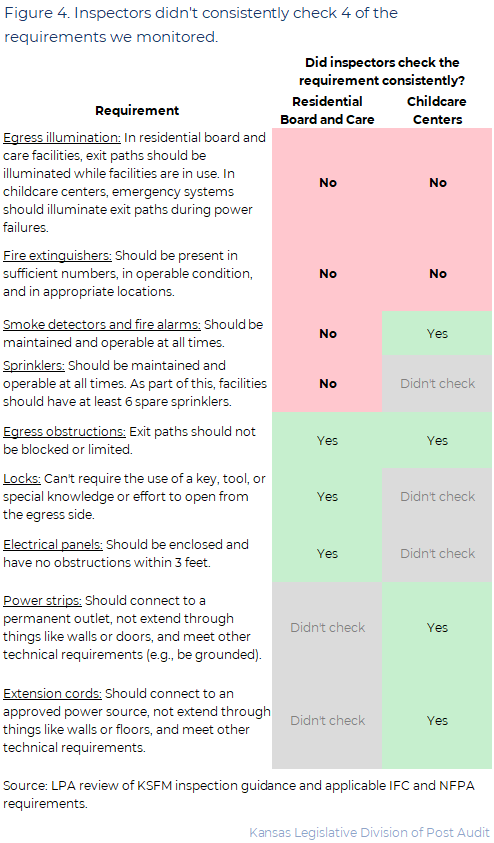
- We found inspectors didn’t check for compliance in the same way for 4 of the 9 requirements we reviewed.
- The inspectors checked emergency lighting in inconsistent ways. Facilities must illuminate exit paths from buildings. 2 inspectors checked facilities’ exterior lighting, but the other 3 didn’t.
- Inspectors also were inconsistent in how they checked fire extinguishers. 2 inspectors checked some (i.e., not all) fire extinguishers. The other 3 checked all fire extinguishers.
- The inspectors we observed did different things to check fire alarm systems. All 5 inspectors reviewed fire alarm system documentation and visually inspected fire alarm systems. However, 2 inspectors tested residential board and care facilities’ systems by setting off fire alarms. The other 3 didn’t.
- Lastly, they did inconsistent checks of sprinkler systems. 1 inspector told us they don’t count the number of facilities’ spare sprinklers and instead appeared to estimate the number. By contrast, another inspector counted each spare sprinkler. As a result, that inspector determined a facility only had 5 of the 6 required spares.
- We also noted a few other inconsistencies. For example, we saw 1 inspector climb into the ceiling to check a residential facility’s fire walls. We saw 2 other inspectors check whether facilities appropriately stored flammable materials. These weren’t things we saw the other inspectors do. But we couldn’t tell if these were things other inspectors should’ve checked and missed, or if these things were only relevant in a few of the facilities we visited.
- It’s important for inspectors to check requirements in consistent ways. If inspectors check the same requirements in different ways, it means they have different expectations for what facilities should be doing. It also increases the risk they miss violations or cite something in one year that’s not been cited before. Both these issues can be confusing to facilities.
The inspectors we observed didn’t consistently identify or cite facilities for violations.
- Inspectors should consistently identify violations when they are present. They should then cite facilities for all violations they identify. KSFM officials told us they expect inspectors to cite all violations they identify even if facilities fix them during inspections.
- In the 10 inspections we observed, the 5 inspectors didn’t always identify violations they should have. They also sometimes chose not to cite facilities for certain violations.
- 2 inspectors didn’t identify obstructions to exit paths from facilities. All 5 inspectors checked to ensure doors and paths were not obstructed. But 2 inspectors didn’t cite obstructions they should have. In one facility, an inspector did not cite a rock that was holding a backyard gate closed as an obstruction. In another facility, a different inspector didn’t cite a brick that was holding 1 side of a double door closed as an obstruction. KSFM officials told us both of those situations should have been violations.
- 2 inspectors didn’t cite facilities for obstructed fire extinguishers. 2 inspectors who identified obstructed fire extinguishers allowed facility representatives to remove the obstructions while the inspectors were present and didn’t cite them as violations. By contrast, a third inspector identified an obstructed extinguisher and cited the facility for it. The other 2 inspectors did not identify obstructed fire extinguishers during the inspections we were part of.
- 1 inspector didn’t cite a facility for a dirty sprinkler head. 4 inspectors checked to ensure residential board and care facilities’ sprinklers were free from dirt and debris such as grease. Only 1 inspector identified a sprinkler head as being dirty, but they did not cite it as a violation. The fifth inspector didn’t check the facility’s sprinkler system because it didn’t have one.
- 2 inspectors appeared to take more lenient approaches to inspections than the other 3. We say this because those 2 inspectors didn’t cite certain violations that facilities fixed during the inspections. By contrast, the other 3 inspectors cited all violations they identified, even if the facility fixed the issue right then. This inconsistency is important because it affects how many violations facilities receive.
- It’s important for inspectors to consistently identify and cite violations. If inspectors don’t identify violations, then it means they’re missing fire safety risks. Additionally, facilities may be confused if another inspector later identifies previously missed violations. It’s also important for inspectors to consistently cite violations they identify. Consistently citing violations ensures facilities know the requirements they’re supposed to meet and have similar inspection experiences. Consistently citing violations also ensures KSFM can track whether facilities have the same violations year over year.
Several inspection reports we reviewed revealed instances where past inspections didn’t cite violations that more recent inspections cited.
- Inspections should be consistent both across inspectors and over time. We reviewed documentation from 16 inspections KSFM did of 10 facilities to see whether there was evidence of inconsistent inspections. We were looking to see whether prior inspections missed violations that more recent inspections caught. For something to be a missed violation, it had to be associated with something a facility wouldn’t likely have changed, such as the types of outlets or doors locks installed. That’s because those things would have likely been present during both older and more recent inspections.
- Our review indicated inconsistent inspections of 3 childcare facilities we reviewed. The 3 facilities were all cited for prohibited locks in their 2025 inspections. 1 facility was also cited for not having ground fault circuit interrupter (GFCI) outlets. GFCI outlets protect against electrical hazards and are required near water sources like sinks. None of the issues were cited during these 3 facilities’ 2024 inspections.
- Our review also indicated inconsistent inspections of 2 nursing homes we reviewed. CMS sometimes inspects nursing homes after KSFM inspects them. This is so CMS can monitor KSFM’s inspections. A CMS follow-up inspection can happen between a few weeks and a few months after KSFM’s initial inspection. We reviewed 4 CMS follow-up inspections at different nursing homes, which identified 6 violations KSFM inspectors missed at 2 facilities. For example, CMS cited a facility for sprinkler gauges that were too old. Those gauges also would’ve been too old at the time of the KSFM inspection. The KSFM inspector didn’t cite the facility for this issue.
- Further, several stakeholders from the inspections we observed told us certain violations surprised them. They said this was because the conditions inspectors cited were present in prior inspections. But inspectors didn’t cite the facilities during those inspections. For example:
- In one childcare center, an inspector cited quilts and carpet hung on walls and exposed wires in 2026. The 2025 inspection also cited the facility’s fire doors as problematic because they didn’t latch into their frames. The facility representative said all these conditions existed for years, but the prior years’ inspections didn’t cite these issues.
- Another inspector cited a childcare center for a multiplug adapter. Multiplug adapters convert one outlet into several outlets. These devices aren’t allowed. The facility representative said they had the adapter during a prior inspection, but the inspector didn’t cite it.
- Inspectors cited a childcare center and residential facility for not having GFCI outlets. Both facility representatives told us they hadn’t been cited for not having these outlets before. The childcare center was also cited for a missing electrical panel cover. Representatives said they hadn’t been cited for that issue before, either.
- It’s important for inspectors to be consistent over time. This aids in setting clear expectations for facilities. If inspectors cite different violations during each routine inspection of a facility but conditions at the facility haven’t changed, it creates ambiguity on what requirements the facility is supposed to meet. This can frustrate facilities because they weren’t made aware they were out of compliance with requirements.
The effects of inconsistent inspections include facility confusion, unexpected expenses, and safety risks.
- Inconsistent inspections can negatively affect facilities by creating confusion and frustration. When inspections are inconsistent, facilities may believe requirements have changed, even though the standards adopted by KSFM have remained the same for past 15 years. And when inspection expectations vary, facilities may be unsure which requirements they must meet or whether they were previously out of compliance. Inconsistencies can also mean facilities have different inspection experiences, which may create fairness or trust issues with the inspection process.
- Inconsistent inspections also may result in unexpected violations, which could in turn result in unexpected expenses. Expenses could be minimal or significant depending on the violation. Violations involving structural issues could have significant costs. For example, 1 facility stakeholder told us an issue identified in their 2025 inspection cost the facility more than $20,000 to fix. They said the issue, which involved fire doors that didn’t latch into their frames, hadn’t been identified in their 2024 inspection.
- Ultimately, inconsistent inspections increase the risk facilities aren’t fully protected against fire hazards. If inspections miss violations, it could allow dangerous conditions to exist in facilities. And the risk increases that facilities and residents will not be appropriately protected if there’s a fire.
Inadequately Supported Violations
Inspectors didn’t adequately support more than half of the violations we reviewed.
- Inspectors should adequately support the violations they cited during inspections. For violations to be adequately supported, we expected them to meet 2 criteria:
- Violations had to be based on applicable requirements. This means violations had to relate to appropriate requirements in fire safety code that apply to the inspected facilities. It’s important for violations to have references to applicable requirements because that makes it clear KSFM’s violations are based on requirements facilities should be following.
- Violations had to be supported by clear and accurate references to the requirements facilities weren’t meeting. It’s important for references to be clear and accurate because they clarify what facilities should do (or not do) to meet requirements.
- Of the 16 KSFM inspections that we reviewed documentation for, we did an in-depth evaluation of 12 to determine whether inspectors adequately supported the violations they cited.
- In the 12 inspections we reviewed, inspectors cited 53 violations. We reviewed each violation the inspectors described. Then, we reviewed the references inspectors used to support each violation. We compared references to the violations to determine whether the citations were applicable, clear, and accurate.
- 24 of the 53 violations (45%) were based on applicable requirements and provided clear and accurate references.
- However, the remaining 29 violations (55%) were either not based on applicable requirements or didn’t provide clear and accurate references, or both. The issues are described more in the following sections.
- We relied on our professional judgment and consultation with KSFM officials to determine whether inspectors identified violations that were adequately supported. We think our evaluations are reasonable. But we aren’t trained fire inspectors. And we had limited information (e.g., inspectors’ brief descriptions of their observations) to review.
5 of the 53 violations (9%) we reviewed were incorrect because they were based on requirements that weren’t applicable.
- 5 violations didn’t have a basis in applicable standards and didn’t provide clear and accurate references to fire safety code. This suggests inspectors shouldn’t have cited facilities for these violations.
- 3 of these 5 violations were at the same residential facility. The inspector cited the facility for having damaged fire alarm, sprinkler, and generator systems. A lightning strike damaged the systems. The inspector’s notes suggest the facility was doing what it should have to address the damaged systems. For example, the facility instituted more frequent physical checks because the systems were down and it had technicians on site doing maintenance. KSFM officials told us the inspector should not have cited the damaged systems as violations because the facility hadn’t done anything wrong.
- The remaining 2 violations were at 2 separate facilities and did not appear to be supported by applicable requirements.
- A residential facility received a violation for not adequately varying the times of its fire drills. The reference the inspector used was related to fire drills. However, the reference didn’t require varied drill times. There doesn’t appear to be a requirement that residential facilities vary their drill times. Residential board and care facilities must do 6 bimonthly fire drills per year. 2 of the 6 drills must be at night. But there are no further requirements that the drills be any more varied than that.
- A childcare facility received a violation for having a decorative tree within 24 inches of the ceiling. The references the inspector used concerned upholstered furniture, mattresses, and natural cut trees. The facility’s decorative tree was artificial, so the references weren’t accurate. Other requirements may have been more relevant. For example, there’s a requirement that artificial decorative vegetation meet flame propagation criteria. There’s another requirement that facilities not store things within 24 inches of the ceiling in facilities without sprinklers. However, the facility appeared to comply with those requirements. That’s because the decorative tree appeared to meet flame propagation criteria and the facility had sprinklers.
24 of the 53 violations (45%) that we reviewed were based on applicable requirements but didn’t provide clear and accurate references to fire safety code.
- We noted 24 violations were based on inaccurate or unclear references to fire safety code. These violations appeared to be legitimate violations of fire safety code, but the references inspectors used either weren’t correct or weren’t clear. For example:
- A residential facility received a violation for kitchen appliances plugged into power strips. The references the inspector used (2008 NFPA 70, 110.26(A)(1) and 408.18) weren’t related to power strips or kitchen appliances. The references the inspector cited were about switchboards and working space. According to KSFM officials, standards limit how much power appliances can draw. They said kitchen appliances generally draw too much power to use with power strips. If this was the inspector’s concern, KSFM officials told us that an accurate reference may have been 2008 NFPA 70 210.23 which limits how much power can be drawn from outlets.
- A childcare facility received a violation because the facility stored combustible material near a furnace. The reference the inspector used was to the state law that allows KSFM to adopt rules and regulations (K.S.A. 31-133). A more accurate reference may have been to 2006 IFC 315.2. That reference requires combustible materials to be separated from heating devices.
- A childcare facility received a violation for bolt locks that required 2 motions to open on one of their doors. However, the reference the inspector cited was for obstructions to exit paths (2006 IFC, 1003.6). We determined 2 other references would have been clearer because they identify the root problem being the lock, not obstructions. 2006 IFC 1008.1.8.4 explicitly prohibits bolt locks and 2006 IFC 1008.1.8.5 requires doors not to take more than one motion to unlatch.
- We also saw examples of unclear and inaccurate references in the inspections we observed. We didn’t systematically review the references inspectors used in those inspections. But we noted a few cases where it appeared to us inspectors sometimes used incorrect references. For example, 2 inspectors cited facilities for not having GFCI outlets. The references they used didn’t require GFCI outlets, though. The references they used were about temporary wiring and required covers for outlet boxes.
The effects of inadequately supported violations include facility confusion and unnecessary fixes.
- Inadequately supported violations can have negative effects on facilities. Violations based on inapplicable references may cause facilities to change things they don’t need to. Further, violations based on inaccurate or unclear references may confuse facilities.
- Inapplicable violations may create unnecessary burdens or costs for facilities. For example, incorrectly requiring residential facilities to vary fire drill times could increase the facility’s administrative burden. Additionally, if a facility pays to fix an inaccurate violation, it’s bearing an unnecessary cost. For example, 1 stakeholder told us an inspector said a residential facility needed to install a sidewalk leading to an exit door. The stakeholder said the facility installed the sidewalk for about $5,000. The stakeholder said KSFM officials later told the facility it didn’t need to install the sidewalk.
- Inaccurate references may confuse facilities. That’s because inaccurate references don’t address the problems inspectors cited facilities for. This could result in facilities not understanding violations or thinking KSFM is holding them to standards that aren’t appropriate. It can also diminish facilities’ trust in inspectors’ competency, causing them to discount inspection results.
- Unclear references may complicate facilities’ abilities to fix problems. That’s because unclear references may make it hard for facilities to determine what they need to fix. This could result in facilities doing more than they need to. For example, a facility with a prohibited type of locking device could address the violation by removing or changing the lock. However, if the reference in the violation report is to a standard about exit obstructions, the facility could interpret the citation to mean they need to remove or replace the entire door.
Causes of Inspection Issues
Fire safety inspections require inspectors to keep track of thousands of requirements, which increases the likelihood inspectors are inconsistent.
- The Kansas fire prevention code consists of about 20 different sets of standards. The main standards KSFM uses for fire safety inspections are the 2006 International Fire Code (IFC) and the 2006 NFPA Life Safety Code. However, those standards reference the other standards KSFM adopted. The 2 main standards describe in general what things facilities must do. The other standards describe in more detail how facilities must do those things. In total, these standards include thousands of pages of requirements. Additionally, KSFM must inspect nursing homes based on the 2012 edition of the NFPA Life Safety Code. That’s a CMS requirement.
- Not all requirements apply to all facilities. For example, IFC standards apply to childcare facilities. Life Safety Code standards apply to residential facilities. Even with a single code, not all requirements apply to all facilities. For example, the Life Safety Code distinguishes between health care facilities (including nursing homes), small residential board and care facilities, and large residential board and care facilities. It also distinguishes between new occupancies of these types and existing occupancies. The requirements for each occupancy vary.
- Requirements range from ambiguous to detailed. This means inspectors need to be aware of detailed technical requirements such as whether egress doors meet minimum width requirements, swing in the correct direction, and open with no more than 5 pounds of force applied to the latch side. They must also interpret and apply subjective requirements, such as whether doors require “special knowledge or effort” to open.
- KSFM inspectors inspect all kinds of facilities. So, they must keep track of which requirements apply to which facilities. There’s a risk inspectors confuse or overlook certain requirements because of their sheer volume and complexities. This problem is further exacerbated by process deficiencies we discuss below.
KSFM had inadequate controls in 4 areas that best practices recommend for inspection programs.
- We evaluated whether KSFM designed controls that would help ensure inspectors do consistent and adequately supported inspections. We reviewed 4 areas in which best practices suggest inspection programs have controls: inspection policies, inspection checklists, inspector onboarding and training, and quality assurance.
- We used our professional judgment to identify controls KSFM should have designed in each area. To do this, we reviewed best practices and solicited input from stakeholders like other states’ fire marshals’ offices.
- We compared the controls KSFM had in calendar years 2024 and 2025 to the controls we expected to see based on our review of best practices. We identified shortcomings in each of the 4 areas we evaluated. These shortcomings likely contributed to the inspection problems we observed. We discuss the shortcomings in the following sections.
KSFM lacked adequately documented policies for inspections of residential and childcare facilities.
- Best practices say KSFM should provide guidance to its staff on how to do inspections. Based on this, we expected KSFM to have documented policies that explained what inspectors should do before, during, and after an inspection, and how inspectors should document their inspection findings.
- KSFM’s inspection policies were inadequate because they didn’t provide clear guidance or reflect KSFM’s current practices. For example, KSFM’s policies don’t say how inspectors should record inspection observations in the field. Instead, KSFM’s policies talk about using KSFM’s database system, Firehouse, in the field. KSFM inspectors can’t and don’t use Firehouse in the field. That’s because Firehouse is an outdated and unsupported system and can only be used via computers.
- KSFM officials agreed their policies were outdated. This is likely because KSFM didn’t have a process to routinely review and update policies. Officials told us they’re currently updating their inspection policies. They said the updated policies will include more specific guidance. They also told us they’re upgrading to new inspection software inspectors will be able to use in the field.
KSFM lacked checklists or other guidance that would ensure inspectors do complete and consistent inspections.
- Best practices say KSFM should have standardized checklists or guides that identify requirements inspectors should check. The checklists or guides should explain how inspectors should determine whether facilities meet applicable requirements. They should also allow inspectors to record that they check for compliance with all applicable requirements.
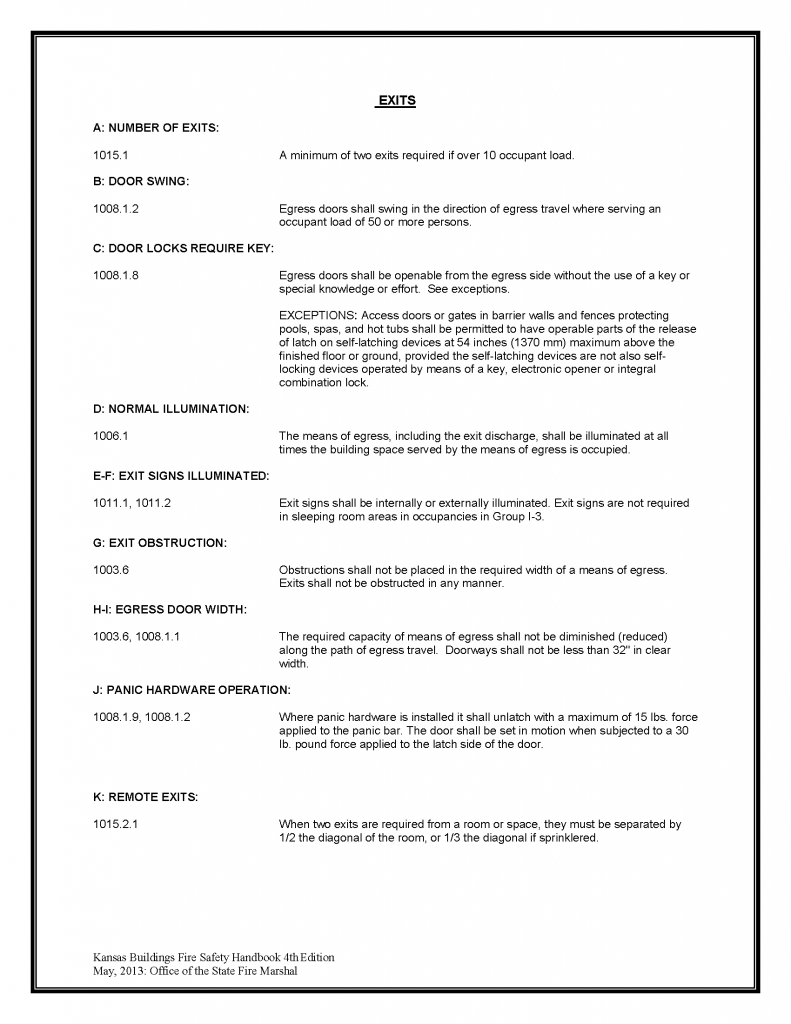
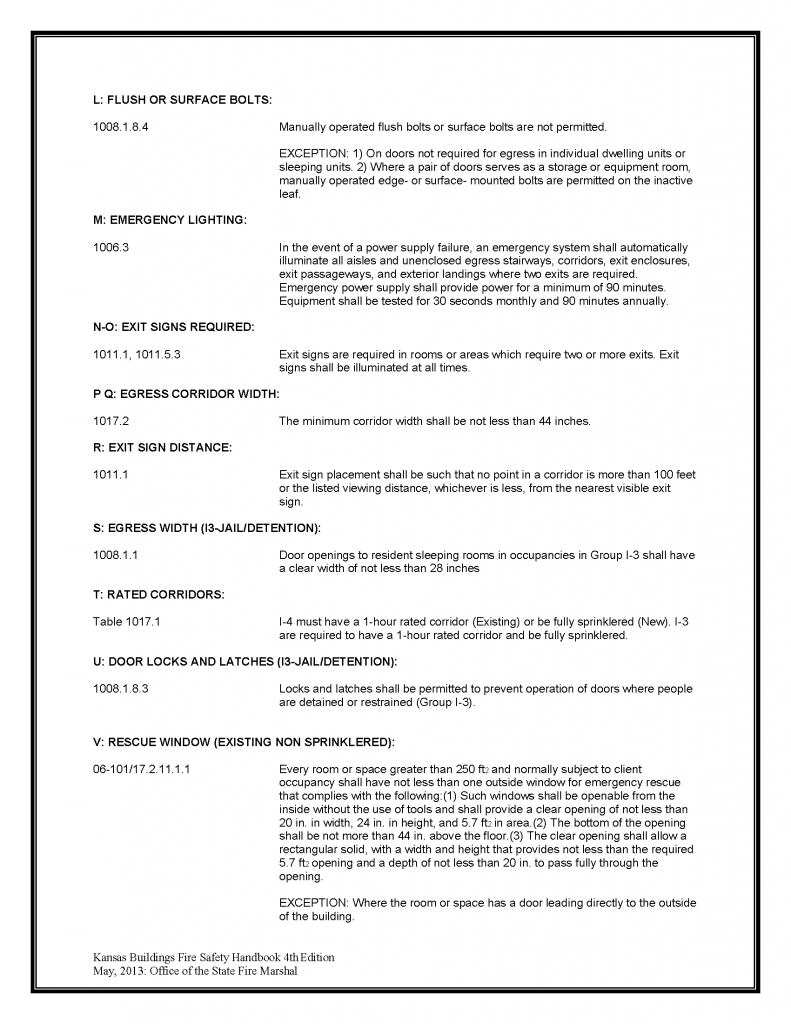
- KSFM had facility-specific guidance that identifies the minimum requirements inspectors should check. KSFM refers to these documents as occupancy checklists. Appendix C shows what these documents look like. These documents didn’t meet our expectations for inspection checklists for 2 reasons:
- The documents weren’t complete checklists. They didn’t include checkboxes inspectors could use to show they checked each requirement. They also didn’t include all requirements inspectors may check for compliance with.
- The documents didn’t provide interpretive guidance by explaining how inspectors should determine whether facilities meet requirements. For example, the childcare facility document in Appendix C says inspectors should check whether egress doors can be opened without the use of a key or special knowledge or effort. However, it doesn’t explain how an inspector should decide whether a lock requires special knowledge or effort to open.
- Additionally, when inspectors create violation reports, they use preset references built into KSFM’s inspection management database. The preset references are based on the requirements and references in the facility-specific guidance documents. But those preset references don’t fit all violations inspectors may identify. KSFM officials told us inspectors can create custom references to support specific violations, but they don’t expect inspectors to do this. They told us that inspectors lack the time to do this consistently and that it’s not feasible for KSFM to have preset references for all possible violations. These issues likely contributed to the inadequately supported violations we identified.
- KSFM officials told us they’re developing more detailed checklists with better references to requirements. However, KSFM officials disagreed checklists or guidance documents should give step-by-step or practical guidance. Officials said inspectors learn how to interpret and apply requirements through training and experience. Finally, officials also told us it was infeasible to have complete checklists because of the vast number of requirements.
KSFM didn’t have adequate onboarding processes and lacked ongoing training requirements.
- Best practices say KSFM should train staff to ensure they can do their jobs effectively and efficiently. Based on this, we expected KSFM to have a standardized onboarding process that would prepare new inspectors to do independent inspections. We also expected KSFM to have ongoing training requirements for experienced inspectors.
- KSFM required new inspectors to obtain a certification. But KSFM lacked consistent onboarding processes and ongoing training requirements.
- KSFM officials told us that they required new inspectors to obtain a fire inspector I certification within 1 year of hire. This certification helps ensure inspectors know how to do fire safety inspections. Getting a certification is generally based on passing an examination based on NFPA standards.
- KSFM lacked a consistent onboarding process for new inspectors for most of 2024 and 2025. They assigned new inspectors to shadow a mentor. However, KSFM officials told us the process for assigning inspectors wasn’t structured and new inspectors learned different things depending on who they shadowed. Supervisors informally evaluated new inspectors to determine when they were ready to conduct independent inspections without a mentor. KSFM officials told us that new inspectors were not evaluated on consistent standards because the evaluation process was informal.
- KSFM didn’t have any ongoing training requirements for more experienced inspectors.
- KSFM officials told us they recognized there were issues with KSFM’s onboarding processes. They couldn’t say why the prior KSFM administration didn’t have better training processes. However, they said they implemented a new onboarding process in the past 6 months that follows a consistent schedule and standardized process for evaluating inspectors. Their new onboarding process was too new for us to evaluate.
- Officials also said they plan to require inspectors to maintain their fire inspector I certifications through ongoing training requirements. Officials plan to have inspectors maintain their inspector I certifications through the University of Kansas’s Fire and Rescue Training Institute. However, at the time of this audit, KSFM officials said that certification program wasn’t available.
KSFM didn’t have any quality assurance processes to help management evaluate whether inspectors do consistent and adequately supported inspections.
- Best practices say KSFM should have quality assurance processes to evaluate the effectiveness and efficiency of their inspections. Based on this, we expected KSFM to have things like an appeals process for facilities and a process to monitor the adequacy and consistency of inspections.
- KSFM officials said they had an appeals process. However, we noted the violation reports KSFM sent to facilities didn’t explain that process was available. 1 stakeholder we spoke to expressed concern about this topic. They told us there’s no form a facility can fill out to challenge a violation. This means facilities lack a clear way to formally contest violations. And that may, in turn, mean KSFM management doesn’t learn about problems with the inspection process.
- KSFM lacked processes to measure whether inspectors are doing thorough and consistent inspections. As noted earlier, they didn’t have adequate guidance documents to ensure inspectors consistently check for all applicable requirements. Further, they didn’t have monitoring or oversight processes that would allow them to use aggregate inspection data to identify performance issues such as consistency and accuracy. KSFM officials told us they expect supervisors to review 10% of their inspectors’ work for accuracy. But until recently, officials told us supervisors weren’t required to document their reviews. This means KSFM management couldn’t verify supervisors were doing the reviews and couldn’t use them to evaluate issues across inspectors.
- KSFM officials didn’t say whether they had specific plans to create quality assurance processes to evaluate the effectiveness and efficiency of their inspections.
Other Findings
KSFM lacked adequate processes to ensure facilities correct violations.
- As part of any inspection program, best practices suggest KSFM should have a process to ensure facilities correct violations. The process should include tracking violations to make sure they’re corrected. The process should also include escalating penalties for facilities that continuously fail to mitigate problem findings.
- KSFM had an enforcement process for facilities to fix violations. This process required facilities to submit a corrective action plan (CAP) within 10 days of receiving their violations report. The CAP is written by the facility and is supposed to address each violation and what the planned remedy is. It also required facilities to remediate cited problems within 3 months (or 30 days for CMS facilities). However, KSFM’s enforcement process had shortcomings that may limit its effectiveness:
- KSFM didn’t consistently confirm whether non-CMS facilities corrected violations. KSFM sometimes relied on non-CMS facilities’ correction plans as evidence facilities would correct violations. In those cases, KSFM didn’t check whether facilities actually made corrections until KSFM next inspected the facilities.
- KSFM didn’t have a system of graduated sanctions to penalize facilities that didn’t make corrections. For example, officials told us KSFM didn’t issue financial penalties even though it has the authority to. Officials told us they thought communicating with facilities was more effective than penalties at bringing facilities into compliance. As a result, KSFM primarily relied on repetitively reminding facilities to submit corrective action plans. KSFM officials also told us they didn’t shut down (i.e., issue cease and desist orders to) the types of facilities we reviewed in this audit. Instead, officials told us they relied on the facilities’ licensing agencies for guidance on what to do.
- Inadequate enforcement processes create the risk that violations remain uncorrected. This is something we saw in an inspection we observed. In its prior inspection, the facility got a violation for a hole in the ceiling of its sprinkler system room. The facility didn’t repair the hole after that inspection, which meant it was still present in the inspection we observed a year later. Not ensuring violations are addressed could put facilities and occupants in danger. Further, weak enforcement processes don’t deter future violations.
KSFM didn’t follow its correction process in 2 of the 4 cases we reviewed.
- We reviewed whether KSFM took reasonable steps to require facilities to correct problems. To do this, we judgmentally selected 4 cases from 2024 and 2025 to review KSFM’s correction and enforcement process. We expected KSFM to follow the process officials described to us and to require reasonable corrective actions. The correction process officials described to us allowed facilities 10 days to submit a CAP, followed by an additional 80 days (i.e., 90 days total) to make corrections. When facilities didn’t respond or submitted inadequate CAPs, officials said KSFM staff should have contacted facilities to get responses or to revise their CAPs.
- 2 of the 4 cases we reviewed appeared to follow a timely process. The facilities submitted timely corrective action plans which KSFM approved. Further, both facilities reported making the needed corrections within 30 days.
- The other 2 cases we reviewed deviated from the standard process, but because of a lack of documentation, we couldn’t tell why. In these 2 instances, the 2 facilities objected to some violations. As standard process, the facilities were originally given 90 days to make corrections. However, after the facilities contested violations or requested waivers, KSFM told the facilities they needed to correct certain issues immediately. 1 facility appeared to make the required corrections. The other didn’t and at one point, KSFM recommended KDHE not renew that facility’s license. Both cases were resolved after about 6 months. However, it was unclear if all the violations were remedied.
- KSFM didn’t keep adequate documentation about why they took the actions they did in these 2 cases. KSFM also didn’t document how or whether the issues were ultimately resolved. This made it hard for us to evaluate the reasonableness of KSFM’s actions. That’s because KSFM didn’t clearly explain to the facilities or otherwise document why it did what it did.
- The results of our review aren’t projectable. That’s because we judgmentally selected these facilities based on concerns from stakeholders. They may not be representative of other facilities’ experiences with KSFM’s correction process. We don’t know exactly how many facilities went through the enforcement process in 2024 and 2025. But we know the ones we reviewed are only a small fraction of the facilities that did.
KSFM’s process for inspecting residential and childcare facilities is similar to the processes described by the 3 local jurisdictions we reviewed, but KSFM is using older versions of standards than local jurisdictions.
Local fire departments may conduct fire safety inspections of various facilities for KSFM or for their own purposes.
- State law allows city and county fire departments to inspect facilities, too. This means local departments have the authority to inspect facilities like KSFM does. Local departments may independently inspect facilities for their own purposes or may inspect facilities on behalf of KSFM. For example, local departments can inspect residential facilities (except nursing homes) for KSFM through a written agreement. Thus, some facilities could be inspected by both KSFM and their local department.
- Local fire departments that want to inspect facilities on behalf of KSFM enter into a written agreement with KSFM annually. By entering into agreements, local departments agree to inspect facilities for compliance with the Kansas fire prevention code for KSFM. When carrying out inspections for KSFM, local departments should evaluate facilities using the same requirements KSFM would.
- Local fire departments that do residential or childcare facility inspections for KSFM only have to report the dates of their inspections to KSFM. The local departments keep copies of the inspection results, but they don’t have to send them to KSFM. KSFM officials told us that the local departments are also responsible for following up with facilities about any violations.
- According to KSFM data, 26 to 30 local fire departments did agreement-based inspections of residential facilities each year between 2021 and 2025. And about 58 to 59 did agreement-based inspections of childcare facilities each year between 2021 and 2023. In 2024 and 2025, no local departments did agreement-based inspections of childcare facilities. That’s because KSFM took over doing them all in January 2024. KSFM officials said they did this to increase the consistency of childcare facility inspections.
- Local fire departments can also do independent inspections for their own purposes. For example, they may do inspections to enforce local ordinances. They don’t have to have an agreement with KSFM to do these independent inspections. They can conduct independent inspections of residential facilities including CMS-certified nursing homes and childcare facilities.
- When local fire departments do independent inspections, they check facilities for compliance with state or locally adopted standards. Locally adopted standards are, like the state standards, based on national standards. State standards are the baseline, but local jurisdictions can adopt more stringent standards in addition to what the state requires. We discuss differences between selected local jurisdictions’ standards and the state’s standards in more detail later.
- KSFM doesn’t have data about how many local fire departments did independent inspections of the facilities we reviewed. We worked with KSFM and the Fire Marshal’s Association of Kansas to get email contacts for local departments to gather this information directly. We surveyed 59 local fire departments to determine how many did independent inspections of residential or childcare facilities in 2025. 37 departments (63%) provided complete responses to our survey. Of those respondents, 18 departments reported doing independent inspections of residential or childcare facilities.
We worked with 3 local departments to learn how they inspect residential and childcare facilities.
- This audit asked us to compare local fire departments’ inspection processes for residential and childcare facilities to KSFM’s inspection processes. To do this, we judgmentally selected 3 local departments to work with: the Hays, Olathe, and Newton fire departments. We selected these departments because they reported inspecting most of the residential and childcare facility types included in this audit and because they covered different parts of the state. However, because our selection was judgmental, the results of our work can’t be projected to other departments.
- All 3 departments reported inspecting residential and childcare facilities. However, not all departments inspect all types of these facilities.
- The Hays and Olathe fire departments reported doing both independent and agreement-based inspections.
- The Newton fire department reported it only does independent inspections.
- We interviewed officials from each department on how they do inspections of residential and childcare facilities. As part of this, we identified what standards and major processes they use for inspections.
- We then compared how these selected local departments’ inspection processes compared to KSFM’s processes. We compared departments’ processes regardless of whether they did independent or agreement-based inspections. That’s because KSFM and locals are both checking for compliance with nationally recognized standards.
The 3 local departments described inspection processes that were generally like KSFM’s.
- The 3 local departments we worked with described inspection processes that were like KSFM’s. For example, the local departments and KSFM all told us they:
- Try to do annual inspections of facilities.
- Go on site to conduct inspections and document their findings while on-site (e.g., by taking notes or photos).
- Send facilities violation reports and expect facilities to correct problems.
- Require inspectors have a fire inspector I certification.
- Take an educational approach to inspections instead of an enforcement-oriented approach. For example, they all said they communicated with facilities instead of issuing financial penalties.
- KSFM and the 3 local departments described relying on inspectors’ professional judgment during inspections but did not always appear to use checklists to ensure inspectors check the same things.
- Officials from all 3 local departments told us they have standardized inspection checklists. They said their checklists applied to all facilities. They said they didn’t have separate checklists for different types of facilities. We noted not all fire departments’ checklists included all applicable requirements.
- However, the 3 local departments didn’t always appear to use checklists to ensure inspectors check the same things. That was because local officials said inspectors don’t always use the checklists to determine what to check. They sometimes use their professional experience, instead of the checklists, to identify requirements facilities aren’t meeting. For example, 1 department told us inspectors use their professional judgment to determine what to look for. The 2 other departments told us experienced inspectors may not need to use checklists. Further, because the checklists are not comprehensive, inspectors may identify issues with requirements not included in the checklists.
- Relying on inspectors’ experience and professional judgment increases the risk inspections are inconsistent. Local officials generally said some inconsistency in inspections is unavoidable. This is due to inspectors’ interpretations of code and their professional experience.
- We didn’t shadow any local inspections or review their inspection documentation. That’s in part because there wouldn’t likely have been much for us to review. The 3 local departments told us they don’t have detailed policies. Additionally, 2 departments told us they only identify requirements facilities didn’t meet. That means there’s no record of requirements inspectors checked and found facilities met. So, we can’t say how consistently local inspections followed the processes officials described to us. It also means we couldn’t compare documentation for local departments’ inspections to KSFM’s inspections to evaluate similarities and differences.
KSFM used fire safety codes that are much older than the codes the 3 local departments used.
- KSFM uses the 2006 editions of the International Fire Code (IFC) and the National Fire Protection Association’s Life Safety Code to inspect facilities. Those editions are outdated. The organizations that maintain the standards publish new editions every 3 years. This means Kansas is using editions far behind the most current ones.
- By contrast, all 3 local fire departments we worked with used more recent editions of the IFC. Newton used the 2024 edition of the IFC. Hays used the 2015 edition and Olathe used the 2018 edition. Officials told us both Olathe and Hays planned to move to the 2024 IFC soon.
- To update the standards, KSFM would have to update its rules and regulations. KSFM officials told us they haven’t done this because of how complicated the rules and regulations process is. The process requires a Department of Administration review, an Attorney General’s Office review, and a legislative committee process. According to Department of Administration officials, the process can take anywhere from 6 months to more than a year to complete. KSFM officials told us a prior attempt to update the code stalled for several years.
- KSFM officials said they have begun taking steps to update the fire prevention code to the 2024 editions of standards. However, they expect the rules and regulations process to take a long time because the standards are long and complicated. This may mean the 2027 editions of standards are available before Kansas updates its code to the 2024 editions.
Differences between state and local codes contribute to inspection inconsistencies and stakeholder frustration.
- Facilities may experience inconsistencies between state and local inspections because KSFM and local departments don’t use the same code editions. That’s because the different editions have different requirements. For example, one local department told us the version of the standards they adopted required carbon monoxide detectors in childcare facilities. They told us the 2006 standards KSFM used didn’t require carbon monoxide detectors.
- KSFM’s use of older standards also means KSFM may enforce requirements that are less flexible than newer standards. This is something facility stakeholders were concerned about. For example, 1 stakeholder told us Wichita’s fire department has newer standards that allow residential facilities to use fire-resistant panels instead of sprinklers. The stakeholder said the panels are more cost effective. However, they said KSFM requires facilities to have sprinklers to comply with the older standards. KSFM officials told us Wichita’s standard applies only to 3- and 4-plex residences and wouldn’t apply to the facilities we reviewed as part of this audit.
- These inconsistencies may have affected facilities’ concerns about KSFM’s inspections. If a local department allows a facility to meet different requirements because of the code version they adopted, KSFM’s expectations may seem unreasonable by comparison, and vice versa. Adopting uniform standards may help address these inconsistencies.
- To see how requirements have changed, we compared 7 judgmentally selected requirements from the 2006 and 2024 editions of the IFC and Life Safety Code. We found the outdated standards Kansas uses don’t provide the same protection or flexibility more recent standards do. For example, the 2024 Life Safety Code would allow residential board and care facilities to lock doors to secure patients with dementia. The 2006 edition doesn’t allow this. And the 2024 edition of the IFC allows for educational facilities to include locks on doors to help stop intruders from accessing children. The 2006 edition doesn’t allow this.
- Modernizing the fire prevention code would give facilities more flexible or clearer requirements. It could also make them safer by requiring things like carbon monoxide detectors. However, some of these additional safety requirements could come at a cost if facilities don’t already have the features that would be required under modern standards.
Conclusion
Fire safety inspections will likely always have inconsistencies, but KSFM can and should do more to minimize them. The fire safety inspection system is complex. It involves multiple entities and hundreds of detailed requirements that require professional judgment to interpret and enforce and that differ based on facility type. Because of that, it’s likely that fire safety inspections will have some inconsistencies. However, KSFM lacks good controls, including written guidance, inspection checklists, and oversight processes to identify and correct inconsistent inspections and unclear and inaccurate citations. Although we were only able to review and observe a small number of recent inspections, we identified numerous examples of inconsistencies and questionable citations. Current KSFM administration says they’re taking some steps to address these issues, but they will need to do much more to minimize inconsistencies.
Local fire departments described inspections processes very similar to KSFM’s, but locals apply more recent standards than KSFM, which can cause confusion. The 3 local jurisdictions we reviewed use fire safety standards that are 3-6 editions newer than KSFM. KSFM uses the 2006 editions of the International Fire Code (IFC) and the National Fire Protection Association’s Life Safety Code to inspect facilities. Those editions are outdated and new ones are published every 3 years. By contrast, all 3 local fire departments we worked with used more recent editions of the IFC. Newton used the 2024 edition of the IFC. Hays used the 2015 edition and Olathe used the 2018 edition. Facilities may experience inconsistencies between state and local inspections because these different editions have different requirements. Bringing KSFM’s adopted standards up to date to better align with local jurisdiction’s standards would help minimize inconsistencies and stakeholder frustrations.
Recommendations
- KSFM should finalize and implement the new controls officials described to us in the areas of policies, onboarding processes, and ongoing training requirements.
- Agency Response: The agency initiated a full review and rewrite of division policies and procedures in August 2025 to ensure they reflect current practices and provide clear, practical guidance for inspectors before, during, and after inspections. This effort includes standardizing expectations for how inspections are conducted, documented, and communicated to facilities.
As part of this work, a structured training program has been implemented that includes formal onboarding and ongoing continuing education requirements. The onboarding program, implemented within the past six months, includes defined training benchmarks, mentorship, and competency-based evaluations to ensure inspectors are prepared prior to conducting independent field work. In addition, continuing education requirements are being established to ensure inspectors maintain technical competency and apply code requirements consistently over time.
These efforts are designed to reduce variability, strengthen decision-making, and establish consistent expectations across the division while reinforcing a culture centered on customer service, clear communication, and education of the facilities we serve.
- Agency Response: The agency initiated a full review and rewrite of division policies and procedures in August 2025 to ensure they reflect current practices and provide clear, practical guidance for inspectors before, during, and after inspections. This effort includes standardizing expectations for how inspections are conducted, documented, and communicated to facilities.
- KSFM should develop a process that ensures inspectors consistently check facilities for compliance with the most important requirements and ensure inspectors document they checked all applicable requirements. The process should ensure inspectors evaluate requirements in a consistent manner.
- Agency Response: We are actively developing enhanced, occupancy-specific inspection checklists that provide clearer guidance on applicable requirements and support more consistent and complete documentation of inspection activities. These checklists are being designed to better align with specific code requirements, identify core life safety priorities, and promote a more uniform inspection approach across inspectors, while still allowing for professional judgment where appropriate.
In conjunction with this effort, the division is transitioning from an outdated reporting system to a modern, web-based inspection platform (APX). This updated technology will allow for real-time data entry in the field, improved standardization of code references, more complete documentation of inspection findings, and stronger tracking of violations and corrective actions. It will also provide greater transparency and clarity in reporting, which supports both internal consistency and external understanding.
Together, these improvements are intended to ensure inspectors consistently evaluate and document applicable requirements, while also enhancing communication with facility operators. This supports our broader goal of using inspections as both an enforcement and educational tool, helping facilities better understand expectations and achieve compliance.
- Agency Response: We are actively developing enhanced, occupancy-specific inspection checklists that provide clearer guidance on applicable requirements and support more consistent and complete documentation of inspection activities. These checklists are being designed to better align with specific code requirements, identify core life safety priorities, and promote a more uniform inspection approach across inspectors, while still allowing for professional judgment where appropriate.
- KSFM should develop a process that ensures inspectors use clear and accurate references to support violations. As part of this, KSFM management should periodically review inspection reports to ensure they’re consistent and use appropriate references.
- Agency Response: We are working towards implementing a formal quality assurance framework that includes documented supervisory shadowing of inspections, post-inspection evaluations, and ongoing performance monitoring. This process includes regular reviews of at least 10% of all inspection reports to evaluate consistency, accuracy of cited references, and overall quality of documentation.
Additionally, improvements in checklist design and the implementation of the APX system will support inspectors in selecting more accurate and appropriate code references by providing more standardized and structured guidance within the inspection process.
This approach is designed to culture of coaching, mentorship, and continuous improvement, while strengthening our commitment to customer service by providing clearer, more transparent, and more defensible inspection outcomes.
- Agency Response: We are working towards implementing a formal quality assurance framework that includes documented supervisory shadowing of inspections, post-inspection evaluations, and ongoing performance monitoring. This process includes regular reviews of at least 10% of all inspection reports to evaluate consistency, accuracy of cited references, and overall quality of documentation.
- KSFM should increase its efforts to update the Kansas fire prevention code.
- Agency Response: We are actively working toward the adoption of a custom Kansas Fire Prevention Code aligned with the 2024 ICC standards. Through recent legislation, the agency is required to complete this update by December 31, 2026.
This effort represents a significant modernization of the state’s fire code and is being approached with a strong emphasis on stakeholder engagement, education, and transparency. The agency plans to conduct public outreach and educational opportunities throughout the process to ensure that stakeholders understand upcoming changes and can effectively prepare for implementation.
- Agency Response: We are actively working toward the adoption of a custom Kansas Fire Prevention Code aligned with the 2024 ICC standards. Through recent legislation, the agency is required to complete this update by December 31, 2026.
- The Legislature should consider ways to assist KSFM with future, ongoing updates to the Kansas fire prevention code. For example, the Legislature could consider permanently exempting updates to the fire prevention code from the rules and regulations process or streamlining the process by allowing the fire prevention code to permanently skip certain steps in the typical rules and regulations process.
Agency Response
On April 10, 2026, we provided the draft audit report to the Kansas State Fire Marshal’s Office and the Hays, Olathe, and Newton fire departments. We made minor changes based on their feedback. Since we didn’t have recommendations for the local fire departments, their responses were optional. None of them chose to provide written responses. KSFM’s response is below. KSFM generally agreed with our findings, conclusions, and recommendations.
KSFM Response
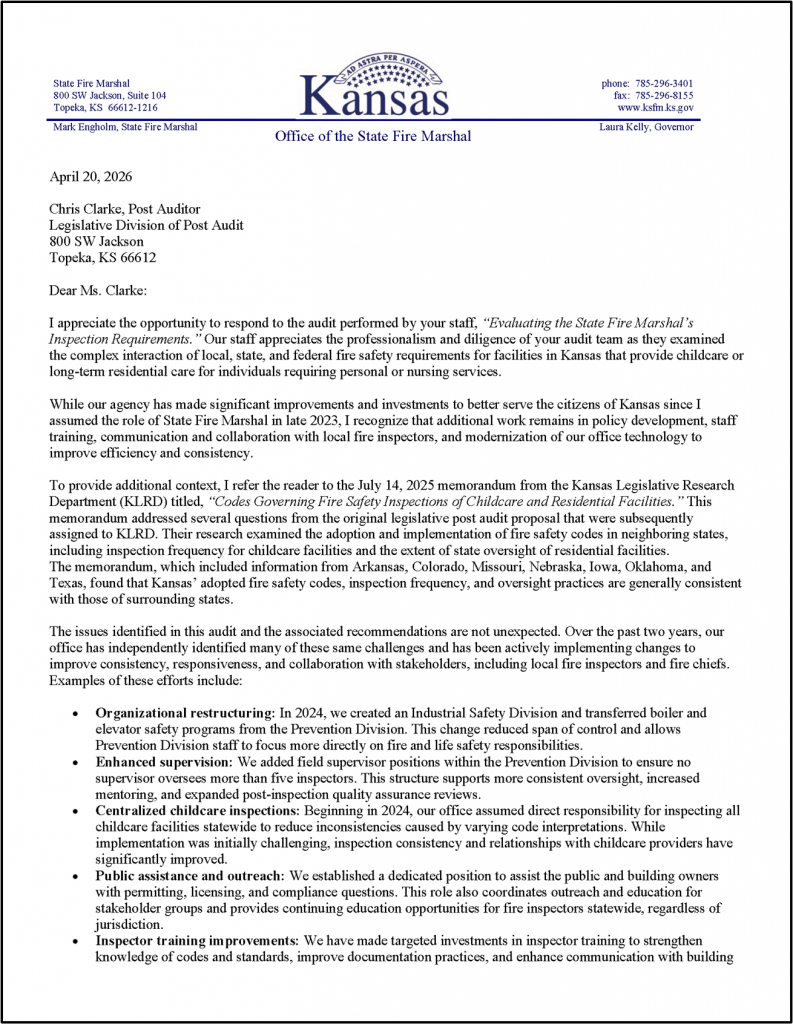
Appendix A – Cited References
This appendix lists the major publications we relied on for this report.
- Carrying Out a State Regulatory Program (2004). National State Auditors Association.
- NFPA 1730: Standard on Organization and Deployment of Fire Prevention Inspection and Code Enforcement, Plan Review, Investigation, and Public Education Operations (2019). The National Fire Protection Association.
Appendix B – A KSFM Violation Report
This appendix includes an example of what a KSFM violation report looks like.
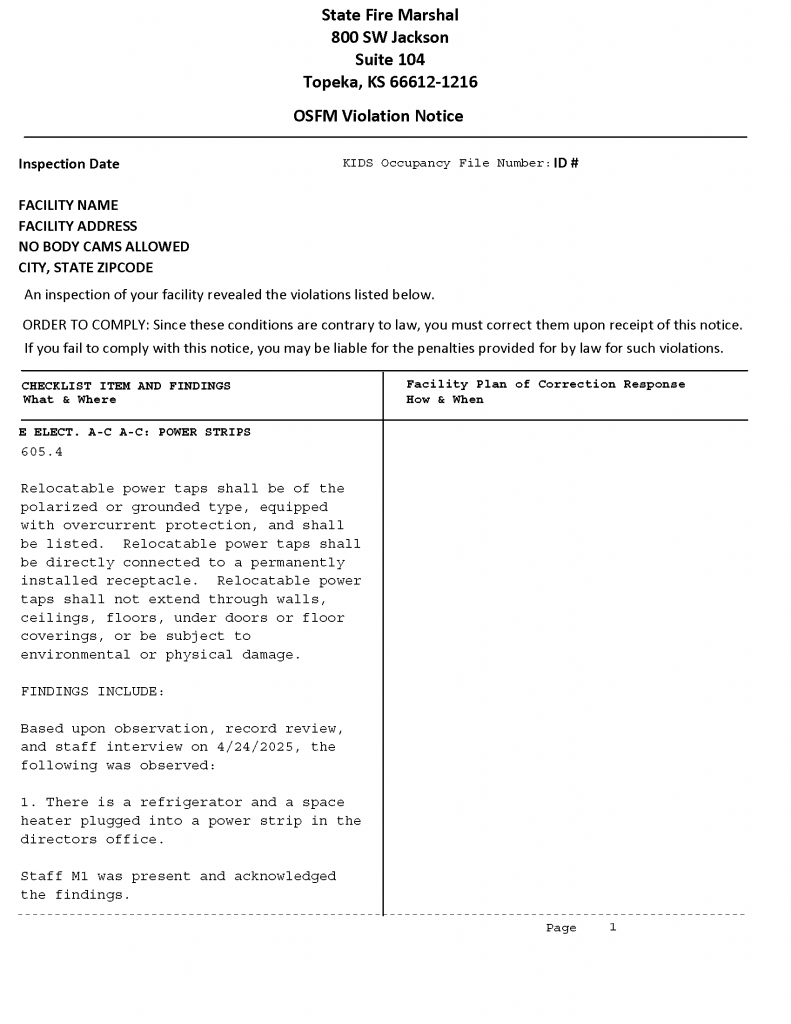
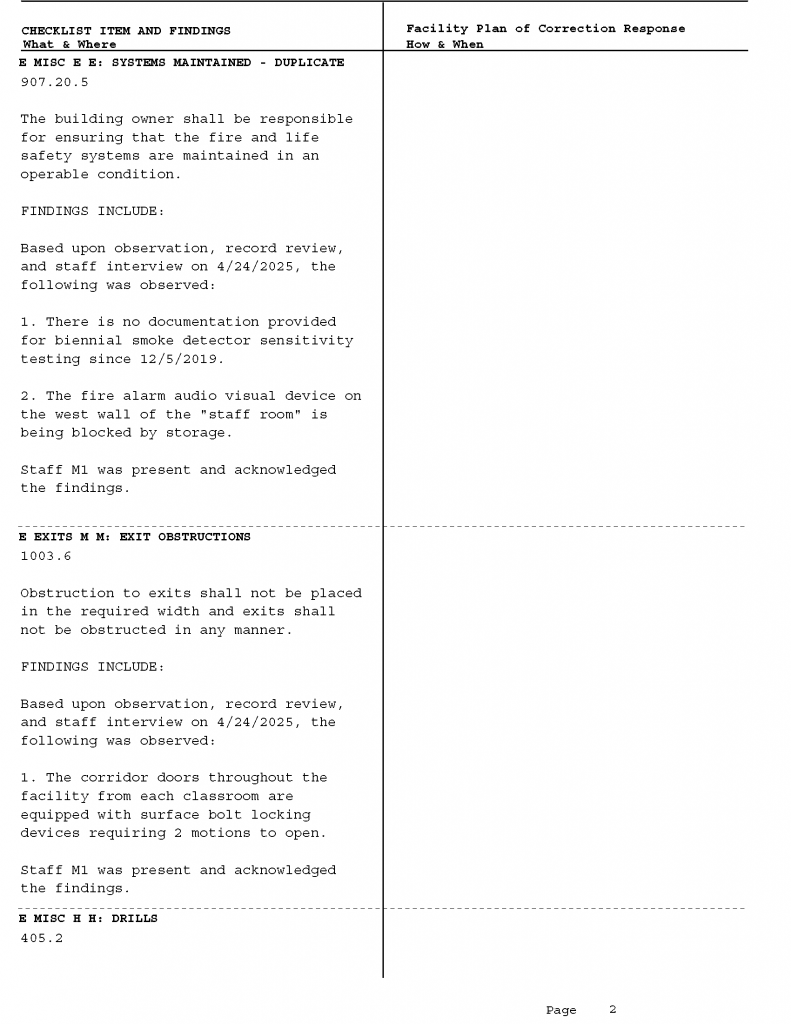
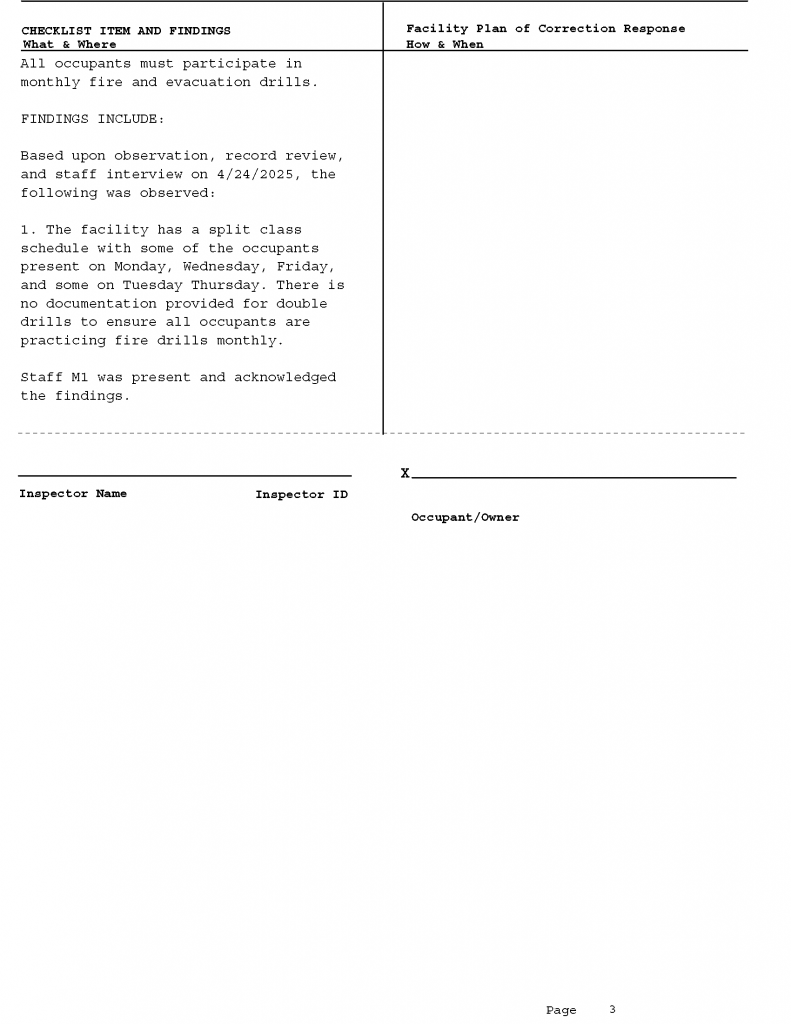
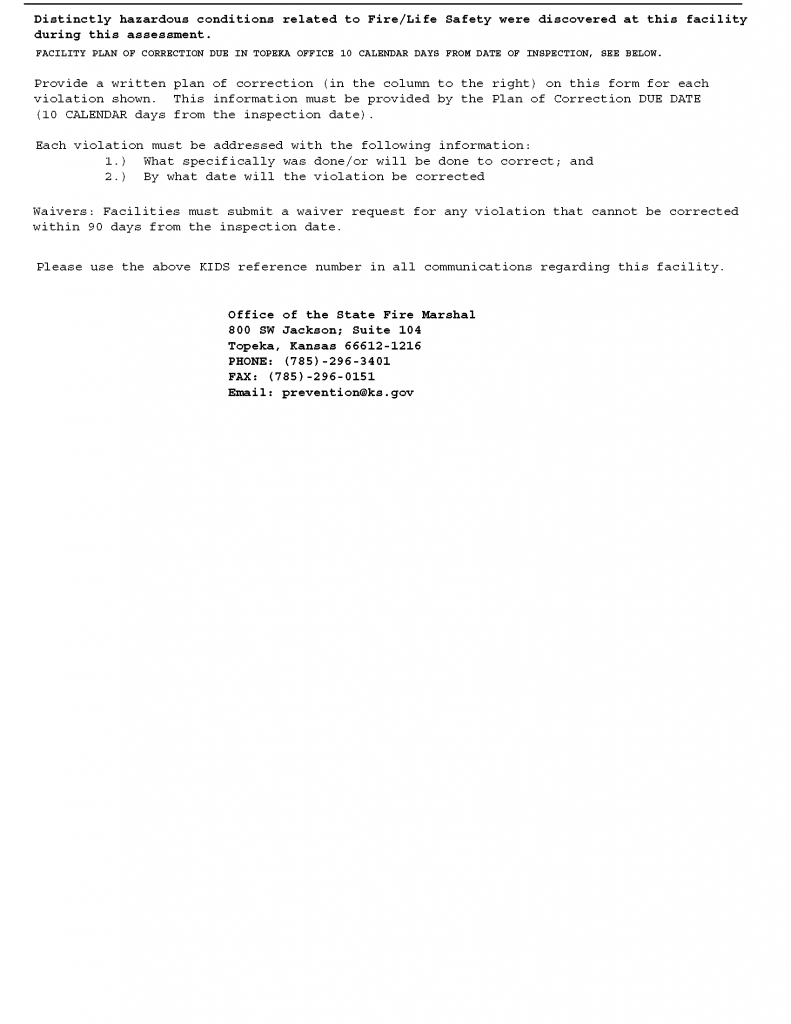
Appendix C – A KSFM Occupancy Checklist