Reviewing Certain KSHSAA and School District Policies Related to Student Participation in Extracurricular Activities
Click Here to Read the Report Highlights Document
Introduction
Senator Renee Erickson requested this audit, which was authorized by the Legislative Post Audit Committee at its April 10, 2025 meeting.
Objectives, Scope, & Methodology
Our audit objective was to answer the following question:
- Do school district and KSHSAA policies comply with state laws allowing virtual and nonpublic-school students to participate in KSHSAA-regulated activities, and what policies do they have for non-KSHSAA-regulated activities?
To answer this question, we talked to officials and reviewed documentation from the 2025-2026 school year from the Kansas State High School Activities Association (KSHSAA) and a non-projectible selection of 20 school districts. This included documentation showing the written policies, student handbooks, and other policy guidance adopted by KSHSAA and the school districts. We compared these documents to the requirements in state law. We also reviewed KSHSAA participation data from the 2023-2024, 2024-2025, and 2025-2026 (as of March 2026) school years to understand how many virtual and nonpublic-school students applied to participate in KSHSAA-regulated activities.
More specific details about the scope of our work and the methods we used are included throughout the report as appropriate.
Important Disclosures
We conducted this performance audit in accordance with generally accepted government auditing standards. Those standards require that we plan and perform the audit to obtain sufficient, appropriate evidence to provide a reasonable basis for our findings and conclusions based on our audit objectives. We believe the evidence obtained provides a reasonable basis for our findings and conclusions based on our audit objectives.
Audit standards require us to report our work on internal controls relevant to our objectives. In this audit, we evaluated KSHSAA’s and a selection of school districts’ policies for ensuring compliance with state law regarding virtual and nonpublic-school student participation in KSHSAA-regulated activities.
Our audit reports and podcasts are available on our website www.kslpa.gov.
KSHSAA and 19 of the 20 school districts we reviewed had written policies that aligned with state law, and 16 of 20 districts said they would also allow participation in non-KSHSAA-regulated activities.
Background
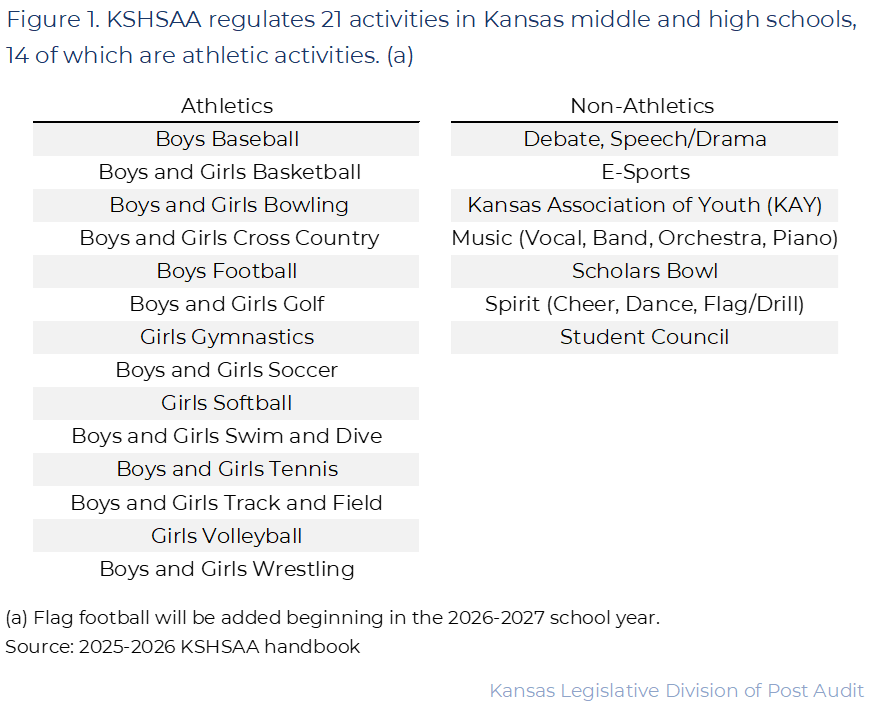
The Kansas State High School Activities Association (KSHSAA) regulates 21 activities for 7th – 12th grades.
- State law (K.S.A. 72-7114, et seq.) outlines KSHSAA’s responsibilities as the statewide association that regulates, supervises, and develops middle and high school activities. KSHSAA is overseen by a board of directors that includes people such as school board members, school administrators, and members of the state board of education. School districts group grades differently, but for this report we refer to 7th and 8th grades as middle school and 9th – 12th grades as high school. Some districts also allow 6th graders to participate in middle school activities. Figure 1 shows the activities KSHSAA regulates for these grades. As the figure shows, KSHSAA regulates athletics, music, drama, and other activities.
- KSHSAA regulates many aspects of these activities. These include things like scheduling seasons and competitions, setting eligibility requirements for students and schools, and setting requirements for practices.
- KSHSAA is responsible for addressing compliance issues when they arise. These issues might include teams fielding players who aren’t eligible or holding practices during periods when they shouldn’t. KSHSAA officials said they educate schools on their requirements and largely trust schools to comply. They said they usually become aware of and investigate problems only when parents, students, or coaches tell them. If a student or school is found to be noncompliant, KSHSAA may overturn their performances or victories or declare them ineligible for future participation.
State law requires school districts to allow eligible virtual and nonpublic-school students to participate in KSHSAA-regulated activities and directly related events.
- Beginning with the 2023-2024 school year, state law (K.S.A. 72-7121) has required school districts to allow eligible virtual and nonpublic-school students to participate in KSHSAA-regulated activities. Virtual students are public school students who attend classes online. The virtual school they attend may be hosted by their local school district or elsewhere in the state. Nonpublic-school students include homeschooled students and students attending private schools.
- The legislature amended state law in May 2025 (2025 Senate Bill 114) to require school districts to also allow virtual and nonpublic-school students to participate in any events directly related to KSHSAA-regulated activities they’ve participated in. These events include things like award ceremonies or banquets. This bill also extended the right to participate in KSHSAA-regulated activities to students enrolled in the Kansas Academy of Math and Science in Hays.
- State law requires virtual and nonpublic-school students to physically reside in the school district where they’re participating. If the district has more than 1 school, they must also participate at the school that covers their home. This is true even if they attend a virtual school hosted by a different district. To be eligible, students must meet all the same age and eligibility requirements as the students enrolled in the district. These requirements include things like being in good standing academically and behaviorally, paying any required fees, and attending any required tryouts.
- State law requires school districts to treat virtual and nonpublic-school students the same as the students enrolled in the district. Districts can impose stricter eligibility requirements than KSHSAA does, such as higher academic standards. But these requirements must be the same for all students.
- Finally, school districts generally can’t require virtual and nonpublic-school students to enroll in classes to participate in activities. Prior to 2024, districts could require virtual students to enroll in at least 1 in-person class as a condition of participation. Currently, districts can only require enrollment in classes all students must take to participate in an activity, such as the band class to participate in an instrumental music ensemble.
To participate in a KSHSAA-regulated activity, virtual and nonpublic-school students apply online to KSHSAA.
- Virtual and nonpublic-school students generally don’t receive grades from or have regular interactions with school district officials. Because of this, KSHSAA takes on the role of determining whether these students are eligible based on the requirements in state law. For students who are enrolled in the district, eligibility and participation are handled directly by the school they attend rather than by KSHSAA.
- KSHSAA’s online application requires information such as the student’s address, school, grade level, transcripts or homeschool academic progress affidavit, and the activity and school where the student wants to participate. The application opens 1 month before each activity season (fall, winter, spring) to allow time for processing. Middle school students apply once per year, but high school students must reapply for each activity season.
- KSHSAA officials said virtual and nonpublic-school students are held to the same eligibility standards as students enrolled in a school district. 1 KSHSAA official reviews each student’s application to make a preliminary eligibility determination. If a student isn’t eligible, the application is denied. These standards include:
- completion of 5 new courses during the previous semester and current enrollment in 5 new courses,
- being in good standing academically and behaviorally,
- being enrolled and attending class,
- meeting semester requirements, including no more than 4 semesters total for 7th and 8th grades and 8 semesters total for 9th – 12th grades,
- meeting grade-level age requirements, and
- not attempting an ineligible transfer, such as transferring to participate in an activity after being ineligible at a different school.
- In alignment with state law, KSHSAA officials apply some standards differently for virtual and nonpublic school students. For instance, state law (K.S.A. 72-7121) allows homeschooled students to meet KSHSAA’s academic eligibility requirements by providing an affidavit stating they are making satisfactory progress toward the next grade level, rather than a transcript. That’s because homeschooled students may not have access to formal transcripts. Further, KSHSAA’s online application requires parents to attest students are not in violation of the local school district’s code of conduct. For a student enrolled in the district, this would be determined by the school rather than by a parent.
KSHSAA officials decide whether a virtual or nonpublic-school student is eligible to participate in KSHSAA-regulated activities.
- KSHSAA officials begin the application review process by asking the local school district to confirm the student’s address and residency. Virtual and nonpublic-school students must participate in the district and school covering their home. The school districts we talked to do this in different ways. Some asked for proof of address, such as a utility bill. Others said their towns are small enough for them to know where most people live without requiring proof.
- Once the district has confirmed the student’s residency, KSHSAA officials said they use the other information from the application to make the final eligibility determination. KSHSAA then notifies the student and district of their decision. KSHSAA officials said they can work with a student and their family to fix application errors. For example, if a student applied to the wrong district and was denied, KSHSAA can amend the application and send it to the correct district. But this delay may mean the correct district may not be able to confirm residency in time for the student to participate.
- State law (K.S.A. 72-7118) requires KSHSAA to set up an appeals board to hear appeals from parents, students, and school districts. This board must hear appeal requests within 10 days of notification and render an opinion within 5 days of this hearing. We didn’t evaluate this process as part of our audit work.
During the last 3 school years, KSHSAA officials approved 88% of the 3,200 applications they received from virtual and nonpublic-school students.
- We reviewed KSHSAA data to determine how frequently virtual and nonpublic-school students apply to participate in KSHSAA-regulated activities. We looked at the 2023-2024, 2024-2025, and 2025-2026 (as of March 2026) school years. This data primarily included 7th – 12th grades, plus some 6th grade students applying for middle school activities.
- Figure 2 shows how many applications KSHSAA received from virtual and nonpublic-school students in the 3 years we reviewed. As the figure shows, this number increased significantly, from about 600 in 2023-2024 to over 1,500 for 2025-2026 (as of March 2026). This is likely driven by significant increases in the virtual and nonpublic-school student populations during these years, as well as the legislation that has expanded their participation eligibility. High school students must apply for each activity season, so there were more applications than students.
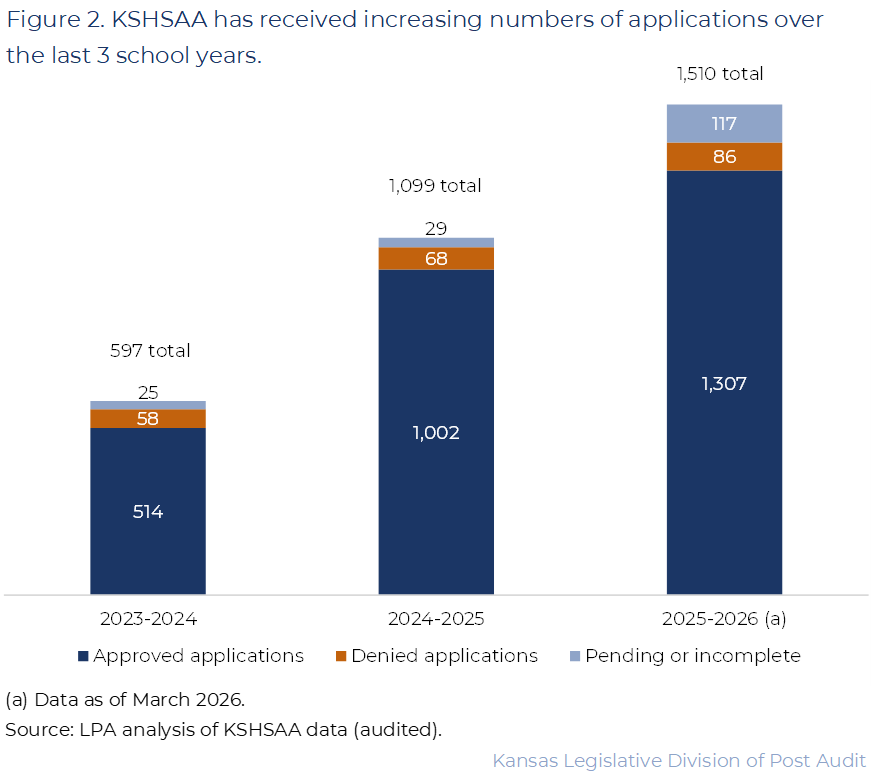
- As the figure also shows, KSHSAA approved most applications it received in these years. Of the 3,206 total applications KSHSAA received, 2,823 (88%) were approved and 212 (7%) were denied. The remaining 171 (5%) applications were either pending or incomplete.
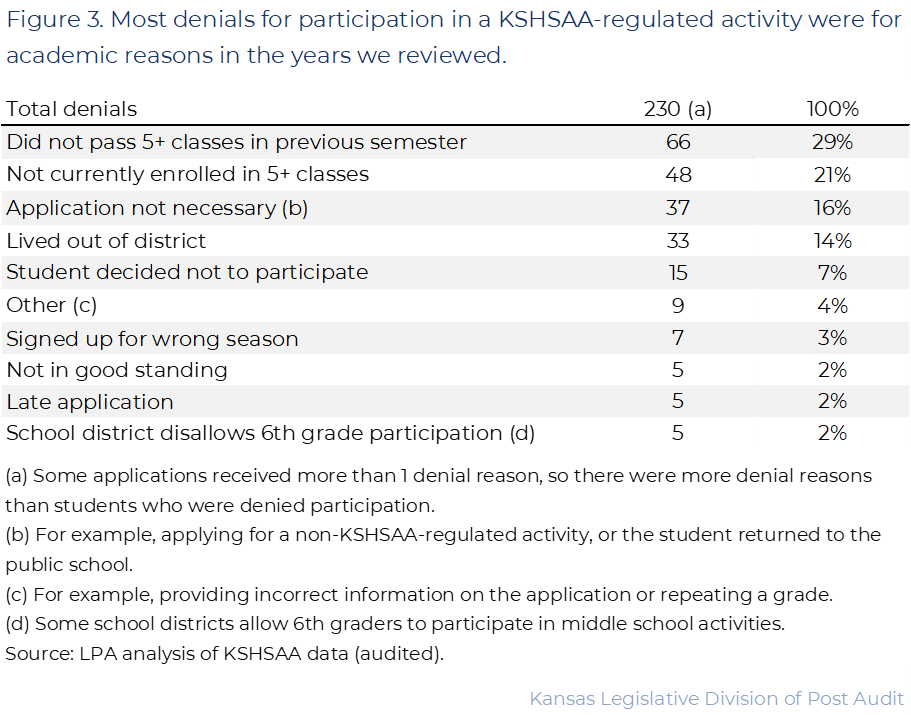
- Most of the 212 denied applications were denied for academic reasons. Figure 3 shows the reasons KSHSAA denied these 212 applications. Some applications had more than 1 denial reason, so there were more denial reasons than applications. As the figure shows, the most common denial reasons were academic. Applications for students who hadn’t passed at least 5 courses in the previous semester accounted for 66 (29%) total denials. Similarly, applications for students who weren’t enrolled in 5 courses when they applied accounted for 48 (21%) total denials.
- It’s important to note that KSHSAA approval doesn’t always lead to activity participation. There may be many reasons for this. For instance, a student may not make a team that requires tryouts, they may be injured and unable to compete, or the activity’s schedule may not end up working for them.
School districts have discretion over whether virtual and nonpublic-school students can participate in non-KSHSAA-regulated activities.
- State law (K.S.A. 72-7121) requires school districts to allow eligible virtual and nonpublic-school students to participate in KSHSAA-regulated activities and directly related events.
- However, state law (K.S.A. 72-7121) gives school districts discretion over whether to allow virtual and nonpublic-school students to participate in non-KSHSAA-regulated activities. These activities include things like Future Business Leaders of America, Future Farmers of America, National Honor Society, plays and musicals, school dances, or class trips.
- KSHSAA has no role in these non-KSHSAA-regulated activities. Whether virtual and nonpublic-school students are allowed to participate is up to each school district.
Findings for KSHSAA-regulated activities and directly related events
We reviewed KSHSAA’s and a selection of 20 school districts’ policies for the 2025-2026 school year to determine whether they align with state law.
- Prior to 2025 Senate Bill 114’s passage, 1 school district denied a nonpublic-school student the chance to participate in an event related to a KSHSAA-regulated activity. State law didn’t require the district to allow participation at the time. Legislators have since expressed concern about whether districts’ policies align with current state law.
- We talked to officials and reviewed documentation to determine whether KSHSAA’s and a selection of school districts’ policies on virtual and nonpublic-school student participation align with state law. This documentation included things like written policies, student handbooks, and school board meeting minutes. We looked at what these things said about virtual and nonpublic-school student participation in KSHSAA-regulated activities and directly related events. We focused on the 2025-2026 school year because that’s when state law began requiring districts to allow these students to participate in directly related events.
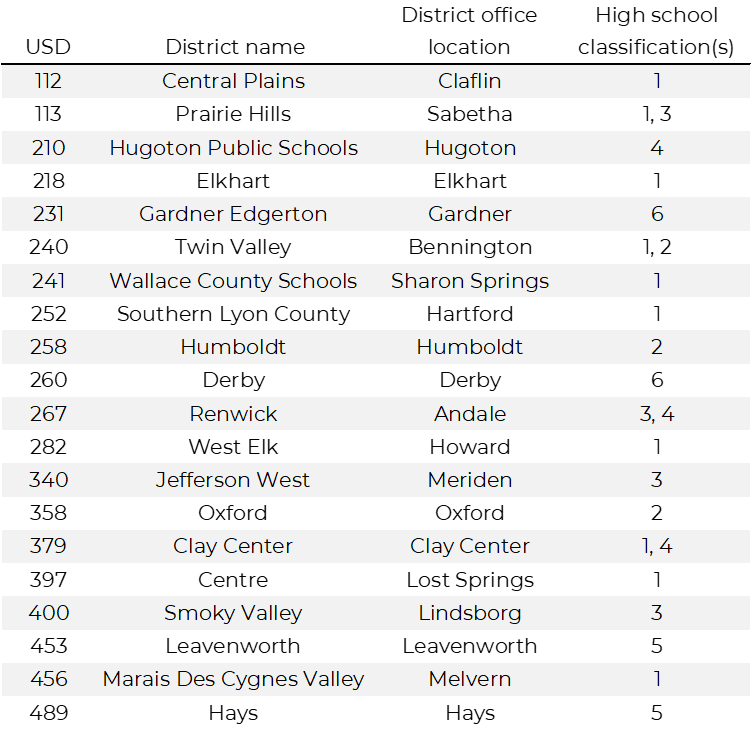
- We reviewed a judgmental selection of 20 out of 285 districts to determine whether their policies on virtual and nonpublic-school student participation align with state law. We selected these districts to include a variety of geographies, sizes, urban/rural settings, and virtual student populations. The results can’t be statistically projected to the population of school districts because the ones we selected aren’t representative of the population. However, the results are likely indicative of issues beyond the 20 districts we reviewed. The 20 districts we reviewed are listed in Appendix A.
- We also reviewed whether these 20 school districts had policies related to virtual and nonpublic-school student participation in non-KSHSAA-regulated activities. Legislators wanted to know whether these districts allowed participation in these activities. State law doesn’t require this, however.
KSHSAA’s 2025-2026 policy for KSHSAA-regulated activities and directly related events aligns with state law.
- The policy KSHSAA adopted for the 2025-2026 school year aligns with state law. This policy mirrors the language used in K.S.A. 72-7121. This includes the most recent changes, which were made by 2025 Senate Bill 114.
- KSHSAA’s policy requires school districts to allow eligible virtual and nonpublic-school students to participate in KSHSAA-regulated activities. The eligibility requirements in the policy match those in state law. The policy also says students who participate in KSHSAA-regulated activities must also be allowed to participate in any directly related events.
19 of the 20 school districts (95%) we reviewed had adopted written policies that align with state law, although 3 adopted their policies after the 2025-2026 school year started.
- 19 of the 20 districts we reviewed had adopted the same template policy. The Kansas Association of School Boards (KASB) created a template policy in June 2025 and provided it to its member school districts for their use. This written policy mirrors the language used in K.S.A. 72-7121. This includes the eligibility requirements for virtual and non-public school students to participate in KSHSAA-regulated activities and any directly related events.
- 16 of the 19 districts (84%) that adopted the KASB template policy made no changes to it. 3 of the 19 districts (16%) made minor changes that didn’t affect their alignment with state law. That’s because they didn’t impose additional requirements on virtual and nonpublic-school students. For instance, USD 489 Hays added academic requirements and deleted a section about requiring tryouts. These changes apply to all students, making them acceptable under state law. USD 231 Gardner Edgerton deleted a section about students who attend the Kansas Academy of Math and Science. This academy is in Hays and doesn’t affect this district.
- However, 3 of the 19 districts that adopted the June 2025 KASB template policy didn’t do this prior to the 2025-2026 school year. USD 231 Gardner Edgerton didn’t adopt this policy until September 2025. USD 358 Oxford didn’t adopt this policy until October 2025. USD 260 Derby didn’t adopt it until January 2026. As a result, their policies didn’t align with state law at the start of the 2025-26 school year. Although this issue has already been addressed, delaying official adoption of an updated policy like this increases the risk that a student may be incorrectly excluded from events directly related to KSHSAA-regulated activities. We didn’t review whether this happened.
- Of the 20 districts we reviewed, only USD 282 West Elk hadn’t adopted a written policy for virtual and nonpublic-school student participation. District officials said they would allow these students to participate in KSHSAA-regulated activities and directly related events. They told us they don’t think they need a written policy because state law and KSHSAA require them to allow participation. However, not having a written district policy increases the risk that a student may be incorrectly excluded from KSHSAA-regulated activities or directly related events. We didn’t review whether this happened.
4 districts hadn’t updated their student handbooks or other guidance documents to align with state law.
- 4 of the 19 districts (21%) that adopted the June 2025 KASB template policy hadn’t updated other district guidance to align with this policy by the time of our audit. Although the districts had officially adopted written policies that aligned with state law, having student handbooks or policies available online that conflict with this policy increases the risk that a student may be incorrectly excluded by a district official. We didn’t review whether this happened.
- 2 districts’ guidance documents didn’t align with the statutory requirement that districts allow virtual and nonpublic-school students to participate in events directly related to KSHSAA-regulated activities.
- USD 453 Leavenworth adopted KASB’s template policy in August 2025. But the district didn’t update the online version of the policy until April 2026. Between these dates, the district’s online policy reflected the old KASB template, which didn’t explicitly require districts to allow participation in events directly related to KSHSAA-regulated activities. We saw evidence that this district updated its online version in April 2026.
- USD 260 Derby adopted KASB’s template policy late (January 2026), as noted above. However, as of April 2026, this district’s student handbook used language from the old KASB template, which didn’t explicitly require districts to allow participation in events directly related to KSHSAA-regulated activities. District officials said they intended to update the handbook to align it with the district’s adopted policy.
- Finally, 2 districts’ guidance documents didn’t align with the statutory requirement that districts generally can’t require virtual or nonpublic-school students to enroll in in-person classes to participate in KSHSAA-regulated activities.
- USD 358 Oxford adopted KASB’s template policy late (October 2025), as noted above. In addition, as of April 2026, this district’s student handbook and other district policies available online incorrectly stated that virtual school students would be required to enroll in at least 1 in-person class to participate in KSHSAA-regulated activities. District officials said they intended to update these materials to align them with the district’s adopted policy.
- USD 340 Jefferson West adopted KASB’s template policy in August 2025. But as of April 2026, the district’s student handbook incorrectly stated that virtual school students would be required to enroll in at least 5 in-person classes to participate in KSHSAA-regulated activities. District officials said they intended to update the handbook to align it with the district’s adopted policy.
School district officials we talked to had varying views on the requirements in state law.
- Some school district officials expressed concerns about allowing virtual and nonpublic-school students to participate in KSHSAA-regulated activities.
- For example, KSHSAA regulates student council, which makes decisions affecting district students. Officials from 1 district said it didn’t make sense for virtual and nonpublic-school students to make decisions affecting a student body they aren’t part of. Any student’s participation in student council would depend on being elected by the student body, however.
- Further, officials from 2 districts pointed out that virtual and nonpublic-school students aren’t subject to the same academic review as district students. Officials from 1 district said this was demoralizing for their students. This is particularly true for homeschooled students, who don’t have to provide academic transcripts to participate.
- Officials from 1 district also expressed concern about erosion of districts’ place in their communities. They said the local school district is a key source of jobs, pride, and cohesion for small communities. They said giving virtual and nonpublic-school students the benefits of the local district without being part of it might harm the district and the community.
- However, other officials said they welcomed virtual and nonpublic-school student participation in KSHSAA-regulated activities. Officials from 2 districts said it was helpful to have more students available for sports teams. They said smaller schools often have trouble finding enough students to field a team.
Findings related to non-KSHSAA-regulated activities
Although not required, 16 of the 20 school districts (80%) we reviewed said they would allow virtual and nonpublic-school student participation in non-KSHSAA-regulated activities.
- State law (K.S.A. 72-7121) gives school districts discretion over whether to allow virtual and nonpublic-school students to participate in non-KSHSAA- regulated activities. These activities include things like Future Business Leaders of America, Future Farmers of America, National Honor Society, plays and musicals, school dances, or class trips. Officials from the districts we reviewed said different districts offer different numbers and types of activities.
- Although it isn’t required, 16 of the 20 districts (80%) we reviewed said they would allow virtual and nonpublic-school students to participate in non-KSHSAA-regulated activities. Some said they would always allow this, whereas others said they would consider this case by case. Of these, 2 districts had written policies allowing this. Although the other 14 districts didn’t have written policies, district officials told us they would generally allow participation.
- However, officials from 4 of the 20 districts (20%) said they generally would not allow participation. None of these 4 had written policies stating this. Officials from 1 district told us non-KSHSAA-regulated activities are intended to build camaraderie among district students, so they wouldn’t be appropriate for other students. However, officials from a couple of these 4 districts said they would allow virtual and nonpublic-school students to attend things like school dances as guests of district students.
- District officials generally told us they have had very few virtual and nonpublic-school students ask to participate in non-KSHSAA-regulated activities. Officials from only 5 of the 20 districts (25%) told us students had tried to participate. All 5 districts said they allow participation in these activities.
Other Findings
While reviewing KSHSAA’s data, we saw 4 instances in which school districts told KSHSAA to deny students’ applications for reasons other than residency.
- As noted above, KSHSAA officials decide whether a virtual or nonpublic-school student is eligible to participate in KSHSAA-regulated activities. KSHSAA only asks school districts to confirm that students are applying to participate in the correct district and school based on where they live. District officials tell KSHSAA whether they should approve or deny applications based on this residency check. KSHSAA officials said they use this information from the district to make the final eligibility determination.
- During our data review, we saw 4 instances out of 3,206 total applications (0.12%) in which school districts incorrectly told KSHSAA an application should be denied. All 4 were for reasons other than the student’s residency. KSHSAA officials denied these applications but told us they shouldn’t have when we asked about this. In 3 cases, the district wanted the student to change or specify which activity they wanted to participate in. 1 district wanted a copy of a homeschooled student’s transcripts, but KSHSAA is responsible for reviewing academic eligibility. State law (K.S.A. 72-7121) also exempts homeschooled students from submitting transcripts.
- KSHSAA officials said they try to review all the denial recommendations they receive from districts but do not have a systematic process for this. Despite this, these appear to be isolated instances rather than a systemic issue.
Conclusion
Nearly all the districts we reviewed had policies to allow virtual and nonpublic-school students to participate in KSHSAA-regulated activities and directly related events as required by law. The 1 district that lacked a written policy still agreed that they’d allow these students to participate. However, a few district officials expressed concern over virtual and nonpublic-school students’ participation in KSHSAA-regulated activities. Officials told us that extending participation to these students could erode student cohesion and culture. Conversely, other districts officials told us they’d allow any student to participate in nearly any activity to help fill rosters, teams, or organizations. Finally, although not required, most districts we reviewed would also allow participation in non-KSHSAA-regulated activities.
Recommendations
- USD 282 West Elk should adopt KASB’s June 2025 template policy for virtual and nonpublic-school student participation in KSHSAA-regulated activities.
- USD 282 Response: USD 282 West Elk fully accepts this recommendation and will take action on this recommendation to adopt KASB’s June 2025 template policy at the next regularly scheduled BOE meeting, June 8th, 2026.
- USD 260 Derby, USD 340 Jefferson West, and USD 358 Oxford should review and update their district handbooks and other written policy documentation to ensure they align with K.S.A. 72-7121.
- USD 260 Response: At Derby Public Schools, we customarily update student handbooks in the spring of each year to ensure the language is ready for online enrollment, with the goal of the language being in effect for the entirety of the following school year. While district administration and the Board of Education were aware of changes in law caused by passage of this bill late in the 2025 Kansas Legislative Session, our staff meetings and preparation regarding updating student handbooks for the 2025-2026 School Year had already occurred. The changes in law, which we operated under during the 2025-2026 school year, will be reflected in writing in the student handbook for the 2026-2027 school year.
- USD 340 Response: We will be updating all of our building handbooks over the summer and will make sure that they all align to each other and consistent with statute, board policies, and recommendations, including the high school.
- USD 358 Response: We want to acknowledge and apologize for an oversight in updating our district handbook in a timely manner. While the policy in question was correctly approved and reflected in the Board of Education adopted minutes, it was unfortunately overlooked during the handbook update process. We do want to clarify that Oxford USD 358 has been following the correct policy and procedures since the time of Board adoption. However, we understand the importance of ensuring our handbook accurately reflects all current policies, and we regret any confusion this discrepancy may have caused. We will be addressing and correcting this issue at our next Board of Education meeting to ensure full alignment moving forward.
Agency Response
On May 13, 2026 we provided the draft audit report to the Kansas State High School Activities Association and the 20 school districts we reviewed. USD 260 Derby and USD 282 West Elk responded. Their responses are below. The other 2 school districts for which we had recommendations declined to submit responses.
USD 260 Derby Response
At Derby Public Schools, since July 2025, we have had 16 students apply, be approved, and participate in KSHSAA activities in accordance with K.S.A. 72-7121’s newest requirements. We welcome virtual and nonpublic-school students to participate in KSHSAA-regulated activities. We believe it is essential to address the findings outlined in this report with clarity, transparency, and accountability. Upholding the law is a fundamental responsibility of public service and one our Board of Education and administrators take seriously in every decision we make. We are committed to ensuring transparent communication with our students, staff, families, and community while also following both the intent and the requirements of state law.
In this situation, the public discussion of SB 114, which was later incorporated into K.S.A. 72-7121, was at an open Board meeting prior to the law taking effect, combined with direct communication to stakeholders and administrative actions aligned with the law, met the expectations of the law, and were done in the spirit of compliance. Our Board of Education follows a deliberate and thorough process when adopting Board policy resulting in pushing the adoption past the start of the school year. Proposed policy language received from KASB is carefully reviewed by district administrators, examined by a Board committee, and then brought before the full Board for discussion and action. This process is intentional because thoughtful governance requires careful review, legal consideration, and transparency. Where the law does not require policy adoption as part of compliance, and our staff was already implementing the law effectively as written, our board and administration did not rush our process. If the Kansas Legislature intends for every law with policy implications to also require written inclusion in Board policies and handbooks, we respectfully request that such expectations be clearly stated within the legislation itself, so that we may consider whether modification of our normal processes is necessary under the circumstances.
USD 282 West Elk Response
As noted in the audit report, West Elk fully follows the virtual and non-public school participation policy/law in practice and has done so from the onset. The district has had both virtual and non-public school students participate under these provisions. An oversight of formal adoption for this policy by the district during annual policy updates/review is the only issue, with formal adoption to take place at the next regularly scheduled BOE meeting, June 8th, 2026.
Appendix A – Selected School Districts
This appendix lists the 20 school districts we selected for review.