
Reviewing Supplemental Nutrition Assistance Program Payment Error Rates and Benefit Card Transactions, Part 2
Introduction
Representative Shannon Francis, Representative Bob Lewis, and Representative Kristey Williams requested this audit, which was authorized by the Legislative Post Audit Committee at its May 12, 2025 meeting.
Objectives, Scope, & Methodology
Our audit objective was to answer the following question:
- To what degree have SNAP benefits in Kansas been misused in recent years?
The original audit proposal included another question related to the cause of the Department of Children and Family’s (DCF) payment error rates for SNAP. We split the audit into 2 reports and released the report related to the payment error rate in January 2026.
The scope of our work for this audit included analyzing transaction data for the Supplemental Nutrition Assistance Program (SNAP) in fiscal years 2023 and 2024. To conduct this work, we reviewed documents provided by the Department for Children and Families (DCF) and conducted interviews with staff to understand DCF’s fraud detection and prevention processes. We also reviewed federal and state laws and regulations to determine what fraud prevention and detection processes DCF must employ regarding SNAP. Additionally, we received all Electronic Benefit Transaction (EBT) data for SNAP recipients in Kansas for the federal fiscal years 2023 and 2024 from DCF. We analyzed a random and projectable sample of transactions to look for indicators of misuse. However, federal laws that prevent DCF from providing personally identifiable and financial information for SNAP recipients to us constrained our ability to analyze data for certain fraud indicators that might be present.
More specific details about the scope of our work and the methods we used are included throughout the report as appropriate.
DCF reported they could not implement our recommendation to offer to place recipient photographs on EBT cards without an additional appropriation by the Legislature.
Important Disclosures
We conducted this performance audit in accordance with generally accepted government auditing standards. Those standards require that we plan and perform the audit to obtain sufficient, appropriate evidence to provide a reasonable basis for our findings and conclusions based on our audit objectives. We believe that the evidence obtained provides a reasonable basis for our findings and conclusions based on our audit objectives.
Audit standards require us to report our work on internal controls relevant to our audit objectives. They also require us to report deficiencies we identified through this work. In this audit, we compared DCF’s SNAP fraud prevention and detection processes to federal and state requirements. We identified 1 state law DCF has not implemented. More specific details about this finding are included in the report.
Our audit reports and podcasts are available on our website www.kslpa.gov.
Based on the limited information we could review, we identified an estimated $700,000 to $1.2 million in SNAP benefits paid to recipients who may not live in Kansas in fiscal years 2023 and 2024.
Fraud and Prevention Detection
The Supplemental Nutrition Assistance Program (SNAP) is a federal program that provides monthly funds to low-income families to buy food.
- SNAP provides a monthly benefit to qualifying families to buy food. SNAP recipients can use the benefit to buy food such as fruits, dairy products, snack foods, and non-alcoholic beverages. Recipients cannot use SNAP funds to buy items such as alcohol, cigarettes, or foods that are hot at the point of sale (for example, rotisserie chicken or fast food).
- The United States Department of Agriculture (USDA) administers the program. However, the Kansas Department for Children and Families (DCF) handles the day-to-day operations. This includes processing applications and distributing benefits.
- Recipients receive SNAP benefits on an electronic benefit transfer (EBT) card that recipients can use at any participating business. Participating retailers include grocery stores, convenience stores, and some online businesses. In 2025, the average benefit for Kansas households was $360 per month.
- The federal government funds the full cost of SNAP benefits. However, the state and the federal government split the state’s administrative costs evenly. Administrative costs can include costs such as verification efforts, informational activities, and application processing. In federal fiscal year 2025, the federal government spent about $403 million on SNAP benefits for Kansans. Additionally, Kansas and the federal government split about $30 million in administrative costs.
- In fiscal year 2025, about 188,000 Kansans received SNAP benefits each month. Since 2021, the number of Kansans receiving SNAP benefits has decreased 7%.
There are a few common types of fraud schemes in the SNAP program.
- We reviewed existing research, federal government reports, and talked to DCF staff to understand the various types of fraud schemes that exist in the SNAP program. Through that work, we identified the following common SNAP fraud schemes:
- Skimming: A form of theft in which bad actors use a skimming device to collect and steal recipients SNAP information and benefits.
- Recipient fraud: Knowingly falsifying information to obtain or continue to obtain SNAP benefits they’re not eligible to receive.
- Cash-for-card schemes: Selling SNAP benefits to another person or to a vendor in exchange for cash.
- Imposter fraud: Occurs when bad actors falsely apply for SNAP benefits using someone else’s stolen identity.
Federal and state law require DCF to take several steps to identify and prevent fraud in the SNAP program.
- Federal law requires DCF to take steps to identify and prevent fraud in the SNAP program. This includes actions such as:
- DCF must monitor for duplicate benefit participation. This means the agency must have a system to ensure that 1 individual does not collect benefits in multiple states. They must also ensure that 1 individual does not collect benefits as part of multiple households. DCF must use names, social security numbers, and other identifiers to prevent this. In February 2026, Kansas joined the USDA’s National Accuracy Clearinghouse. The Clearinghouse verifies that applicants are not already receiving SNAP benefits in another state.
- DCF must establish a fraud investigation unit. The unit must be responsible for detecting, investigating, and assisting in the prosecution of fraud.
- DCF’s EBT system must meet several requirements. For example, each EBT terminal must have a unique identifier and there must be a system to ensure that only eligible participants receive benefits. Additionally, the department must keep an up-to-date and accurate master file of SNAP recipients.
- The department must take steps to secure recipient EBT cards. This includes requiring the use of a PIN at the point of sale. Additionally, DCF must provide training to recipients on the appropriate use and security of their PIN.
- Last, DCF must follow specific rules for replacing lost EBT cards. The department must disable any cards reported lost or stolen. Further, they must notify SNAP recipients who have had 4 EBT cards replaced within 12 months that DCF will monitor the accounts for fraudulent use.
- State law requires DCF to take a couple additional actions to identify and prevent fraud. DCF must establish a system for the public to report suspected fraud to the department. Additionally, DCF must offer to place the recipient’s photo on the EBT card.
- Finally, DCF has also implemented additional policies to prevent fraud. For example, the department allows recipients to temporarily turn off their EBT card and block out-of- state or online purchases from their online account if they lose their card. Further, if DCF suspects theft of an EBT card or account number, it requires the recipient to reset their PIN.
DCF has policies that appear to comply with most of the federal and state requirements we reviewed, but we identified 1 state law DCF has not implemented.
- We reviewed DCF documents and interviewed DCF staff to understand what steps DCF has implemented to prevent and detect fraud in the SNAP program. We compared DCF’s policies to 11 federal and state requirements to determine if the department complied with those laws. Figure 1 shows the 11 requirements we reviewed and whether DCF had policies that complied.
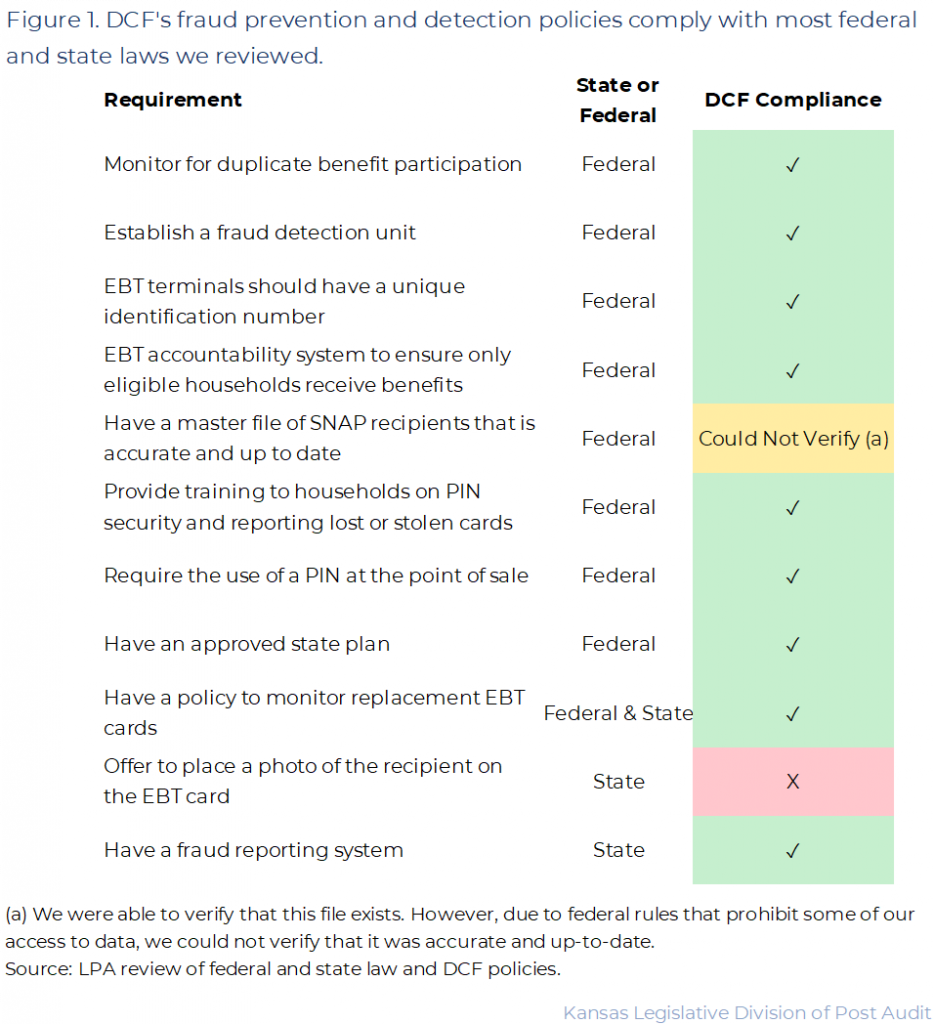
- As the figure shows, DCF complied with most of the state and federal laws we reviewed. For example, DCF has implemented a toll-free hotline for individuals to report fraud or abuse in the SNAP program. The department provides written brochures to SNAP recipients outlining how to use their EBT card and the importance of protecting their PIN. Additionally, DCF has 2 staff members who routinely monitor EBT transactions. They look specifically for patterns that might indicate skimming, trafficking of benefits, or other fraudulent behavior.
- As federal law requires, the department also has a 25-person fraud investigation unit. This unit investigates allegations of fraud in any of the assistance programs that DCF administers. These allegations primarily come from the fraud hotline the department operates or through DCF staff. The unit investigates the allegation and decides whether the action constitutes fraud. If so, they will refer the matter for an administrative hearing or to law enforcement. In fiscal year 2025, DCF reported they referred about 300 allegations (out of 2,674 total allegations) to administrative hearings or to law enforcements. Investigators determined the remainder did not constitute fraud, were not related to programs DCF operates, or were still under investigation.
- However, there was 1 requirement we could not review and 1 requirement DCF has not implemented.
- Federal law requires that DCF maintain an up-to-date and accurate master file of SNAP recipients. Although we could confirm that the file existed, we could not test whether it was accurate and up to date because federal law does not give us access to the details of that data.
- State law (K.S.A. 39-709 (15)(A)) requires DCF to ask recipients’ permission to have their photo included on their EBT card. DCF is required to print recipients’ photos on EBT cards when given permission. However, DCF does not currently offer this. The purpose of the photo is to deter and identify EBT card theft. Without a photo ID, card theft may be harder to identify. Although we asked, DCF officials did not provide an explanation for why they have not implemented this law.
SNAP Misuse
We did several tests to identify SNAP benefits that were potentially being misused, but our analyses were limited by a federal law that prevents DCF from sharing certain SNAP recipient data with us.
- Although DCF has measures in place to deter and identify misuse, misuse can still occur. We designed tests to identify SNAP funds that were potentially misused to answer the audit objective. However, our ability to identify misuse was limited due to federal restrictions on the SNAP data that DCF could provide to us.
- Federal law (7 CFR 272.1(c)) restricts the disclosure of SNAP recipient information. DCF can provide detailed SNAP data only to specific agencies, including:
- employees of the U.S. Comptroller General’s Office,
- agencies directly connected with the administration or enforcement of SNAP,
- agencies directly connected with the administration of the Child Support Program and the National School Lunch Program, and
- law enforcement for the purpose of investigating an alleged SNAP violation.
- Office of the Revisor of Statutes staff told us it would be difficult to argue that LPA meets any of those definitions. As such, we were unable to review detailed recipient data such as financial information or home addresses. This prevented us from looking for potential card trafficking schemes. It also hindered our ability to thoroughly test for benefit misuse. For example, we were unable to look for certain patterns in where recipients use their cards that might indicate theft because we did not know where the recipient lived.
- However, we were able to review SNAP EBT transaction-level data for federal fiscal years 2023 and 2024. DCF provided the data containing nearly 43 million transactions totaling about $1 billion. It contained information such as the card numbers that made the transactions, where the transactions occurred, and the dollar amount of the transactions. The data also included information on the dates DCF added SNAP benefits on EBT cards and the amounts.
- We looked for suspicious patterns in how recipients used their SNAP cards to identify potential misuse. Specifically, we did the following work to identify potential misuse:
- Recipient fraud: We couldn’t evaluate application data to determine if recipients provided accurate information. However, we were able to evaluate whether recipients appeared to live in another state while still getting benefits in Kansas. Our review found instances where recipients continued to receive SNAP benefits in Kansas while appearing to live in another state.
- Cash-for-card schemes: We were limited again by federal law. Here we wanted to evaluate how far and how often recipients traveled to make SNAP purchases. Frequent long trips to a specific vendor could indicate a potential cash-for-card scheme. However, without recipients’ home addresses we could not complete this analysis. Instead, we reviewed the transaction data for unusual spending trends (e.g., even dollar amounts, odd times of day, repeated times of day, etc.). This could still indicate potential misuse. Our limited review didn’t identify any obvious cash-for-card schemes.
- Imposter fraud: We were unable to evaluate imposter fraud because federal law prevented us from seeing recipients’ application materials. We needed to review the application data to identify suspicious trends that might indicate this type of fraud.
- We identified some issues with purchases made from out of state. That’s discussed more below. However, we did not find any other immediately concerning patterns.
Based on the data we could review, we estimated that in fiscal years 2023 and 2024 DCF distributed about $700,000 to $1.2 million in SNAP benefits to recipients who may not have lived in Kansas.
- We selected a random sample of about 10,500 EBT cards (out of 289,623) from fiscal years 2023 and 2024. SNAP recipients used the cards we sampled to make about 1 million food purchase transactions.
- From that sample, we identified cards that made 75% or more of their SNAP purchases in other states. This could indicate the recipient lived in a different state while receiving SNAP benefits in Kansas, which isn’t allowed. Federal and state law require SNAP recipients to live in the state where they receive benefits. However, federal law allows recipients to use benefits in other states. We excluded border states from our analysis for this reason. If a recipient lives in Kansas, but the nearest grocery store is located in a bordering state, these purchases would not be problematic.
- Based on this analysis, we identified 51 SNAP recipients that potentially lived in a different state while receiving a total of about $63,000 in benefits from Kansas. This was out of our sample of about 10,500 cards. We sent the card numbers we identified to DCF to follow up as appropriate.
- On average, recipients received Kansas SNAP benefits for 4 months after they appeared to move. We calculated the duration of being out of state based on 75% or more of purchases being out of state in consecutive months. The longest a recipient continued to receive benefits was 21 months. This recipient may not have accurately reported their address to DCF.
- On average, these recipients received $650 in benefits while potentially living out of state. The most a single recipient received was $5,700.
- Figure 2 shows which states recipients may have lived in while receiving benefits in Kansas. As the figure shows, Kansas SNAP recipients potentially living in Texas, Florida, and Arizona received the most benefits.
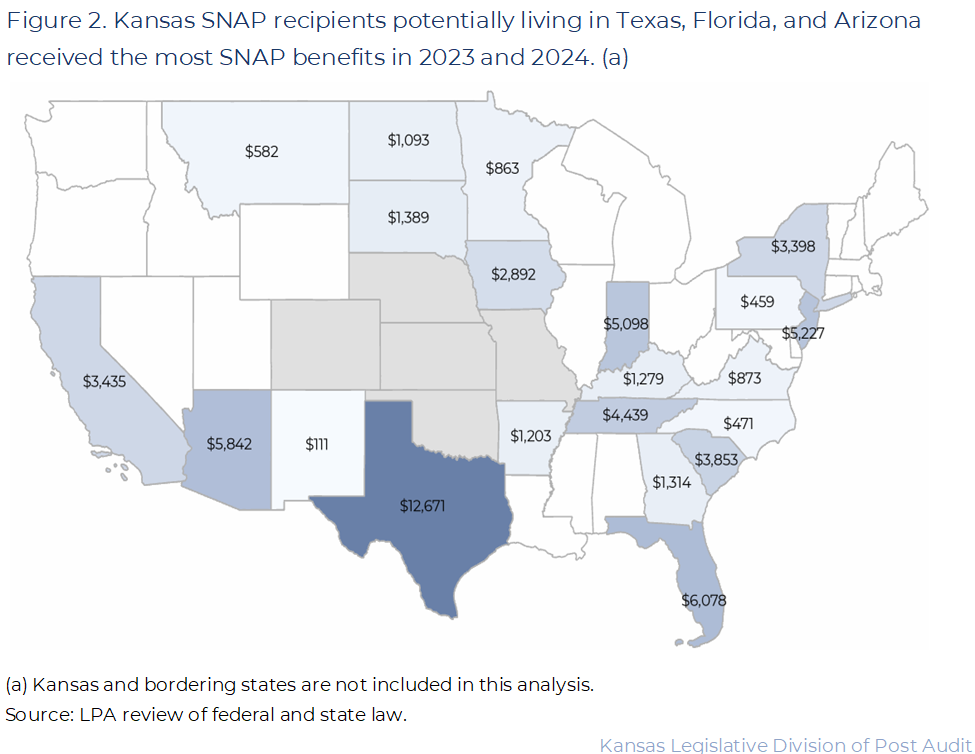
- Because our sample size was statistically large enough and chosen randomly, we were able to project the results of our analysis to the entire SNAP population with a confidence level of 95%. We estimated that in total, about 1,000 to 1,800 SNAP recipients could have received benefits from Kansas despite living out-of-state. That’s about $700,000 to $1.2 million in SNAP benefits. These estimates only apply to fiscal years 2023 and 2024. In total, this represents less than 1% of the state’s spending on SNAP benefits during these years. Although small in comparison to total benefits paid, these transactions still highlight potential misuse within the program.
- Our work has a few important caveats:
- Our estimate of SNAP benefits paid is likely understated. That’s because we excluded transactions in neighboring states. It’s possible that some recipients did move to a border state and we did not include them in our analysis. Further, we did not flag recipients until 75% of their transactions occurred in another state. The amount of benefits paid for a few months of the time frame we evaluated included additional COVID-related benefits. However, because those additional benefits covers only a few months and because of other methodological choices, we think our estimate is still likely understated.
- Additionally, our data only covers 24 months. If the pattern began or continued out of that time frame we would have understated the amount of benefits paid. For example, the data might show that someone made 75% of their purchases out of state, but only for a single month. It’s possible these individuals continued to make out of state purchases prior to or after our 24-month window. We would not be able to identify those trends. As such, those individuals would not be included in our estimate. As a result, we may have understated the amount of benefits some individuals received after potentially leaving the state.
- We were unable to determine if these individuals were also receiving benefits in the state they appeared to move to. Doing so would require gathering information from 21 other states, which we did not have time to pursue as part of this audit.
- Last, the patterns of out-of-state purchases we identified can also indicate a skimming scheme. In skimming schemes, stolen card information is often used to make purchases in other states because they are frequently part of a larger theft ring. We did not have enough information to determine that what we saw is evidence of skimming, but it is possible.
DCF told us that Kansas’s simplified reporting requirements prevent them from quickly identifying when a recipient moves out of state.
- Federal law offers states multiple options for how often and how much information SNAP recipients must report to continue to receive benefits. Nearly all states use one of the following 2 options:
- In simplified reporting states, recipients are required to report only 3 different changes to their circumstances within the first 10 days of the month following the change. This includes certain changes to their wages, changes to the number of hours they work, and if they have lottery winnings greater than $4,500. Additionally, recipients must certify every 6 months that certain financial and household information are still correct.
- In change reporting states, recipients are required to report several types of changes to their circumstances within 10 days. This includes changes to wages, hours worked, address, lottery winnings, and the number of household members.
- Kansas is a simplified reporting state. DCF made this choice because it reduces the administrative burden on both the state and the recipient. However, as a simplified reporting state, DCF has less insight into certain changes in SNAP recipients’ circumstances. DCF staff told us federal rules limit what information they can ask recipients to report within 10 days. For example, as a simplified reporting state, DCF cannot require recipients to report a change of address within 10 days. DCF requires that recipients provide this information at the 6-month certification. However, DCF has only recently (October 2025) required recipients to submit documentation (e.g. a lease agreement) to verify their current address.
- We reviewed federal law regarding simplified reporting for SNAP and talked with federal USDA officials. USDA officials confirmed that DCF, as a simplified reporting state, cannot require SNAP recipients to report a change of address within 10 days. It is possible for Kansas to become a change reporting state, which would allow that information to be collected. However, that change would require additional paperwork from recipients and an increase in administrative tasks for DCF. Due to time constraints, we could not assess the impact of this change on recipients or DCF resource needs.
- Last, because SNAP recipients are not required to report a change of address immediately, DCF can do little to proactively intervene. DCF officials told us they monitor for unusual transactions and can talk with recipients if they see unusual patterns. However, DCF cannot require recipients to report that information. As such, unless the recipient volunteers they are living out of state, DCF cannot stop benefits until the 6-month certification. Further, unless a recipient knowingly misreports their address at the 6-month certification, there are few steps DCF can take to recoup any benefits that were paid while the recipient lived out of state.
Making payments to individuals who have potentially left the state could have a small fiscal impact on Kansas.
- Currently, the federal government covers 100% of the cost of SNAP benefits. This means when a recipient collects a benefit in Kansas even though they live in another state, Kansas does not incur a cost. The federal government only incurs an additional cost if that recipient is collecting benefits in multiple states.
- In 2025, Congress passed the One Big Beautiful Bill which requires states with SNAP payment error rates of 6% or greater to pay a portion of SNAP benefit costs starting in 2028. In 2024, Kansas’s payment error rate was 10%. Should the error rate stay that high, these changes will require Kansas to pay 10% of the state’s SNAP benefit costs. Based on 2025 spending that would be about $41 million. Under this change, we estimate the state would effectively be responsible for paying between about $35,000 and $60,000 annually for SNAP recipients who may no longer live in Kansas.
Conclusion
The Department for Children and Families appears to have the required processes in place to prevent and detect SNAP misuse. However, even with limited data we found instances where recipients may have received benefits after potentially moving from the state. This violates federal and state law which require that a recipient live in the state where they receive benefits. As a simplified reporting state, federal law only requires recipients to immediately report changes in wages, hours worked, and lottery winnings. Recipients are only required to notify DCF of a move out-of-state at the 6-month report and the 12-month certification. Until October 2025 this information was self-reported by recipients and DCF did not routinely require documentation. This made it difficult for DCF to proactively identify recipients who have moved out of state. For example, we saw one case where an individual received benefits for 21 months after potentially moving from Kansas. However, as a simplified reporting state, the federal government does not permit DCF to require SNAP recipients to report a change of address at the time of that change.
Recommendations
- To comply with state law, DCF should offer to place recipient photographs on SNAP EBT cards.
- Agency Response: Without a fiscal appropriation by the legislature to pay for the reissuance of all current (and future) EBT cards with a photo of a household member, the agency cannot begin taking steps to plan for implementation of the recommendation.
Agency Response
On March 4, 2026 we provided the draft audit report to the Department for Children and Families. Its response is below. Agency officials generally agreed with our findings and conclusions, but noted some issues in implementing the recommendation.
- The agency noted some complications with complying with the state law that requires DCF to offer to place recipients photographs on their EBT cards. Specifically, they noted there are a number of situations where the person using the EBT card may not be the person whose photo is on the card. For example, any household member may use the EBT card so the photo may not match the person using the card. Additionally, if a recipient is disabled a caretaker may be using the card. In this case the photo would not match the person using it. DCF officials noted this may impose burdens to using the EBT card if retailers notice the picture on the card does not match the person using the card. DCF also raised issues with the feasibility of requiring all recipients to come to an office to take a picture and the cost of implementing the recommendation.
- Although LPA understands these issues, state law only requires DCF to place a photo of the recipient on the EBT card if the recipient agrees. If the recipient finds this to be a hardship they can decline. Further, state law allows the photo of a guardian to be placed on the card if the recipient is a minor or is incapacitated. If DCF determines that offering to place a picture on the EBT card is not feasible, they should work with the legislature to change the law.
DCF Response
Thank you for the opportunity to provide a response to the Performance Audit Report: Reviewing Supplemental Nutrition Assistance Program (SNAP) Payment Error Rates (PER) and Benefit Card Transactions, Part 2 (March 2026). We appreciated the professional conduct of the LPA staff during the course of the review. The Kansas Department for Children and Families (DCF) respectfully submit the following responses for the audit findings listed below.
DCF would like to offer insight into benefit payments made to clients who may have moved and EBT transaction monitoring:
Since 2000, FNS has required EBT interoperability with each state’s EBT Contract. EBT Interoperability is the technical capability allowing Electronic Benefit Transfer (EBT) cards to be used seamlessly across state borders at authorized retail locations nationwide. However, while it is not illegal to use your EBT card outside of the state where you reside, DCF receives daily reports on EBT transactions and monitors card’s used solely out of state, used several times in a row out of state, and when the transactions are manually keyed instead of swiped. These are all examples of potential fraudulent transactions or a residence change.
Kansas continues to participate quarterly in the Public Assistance Reporting Information System (PARIS) match, federally administered by the Administration for Children and Families (ACF), which checks each beneficiary for participation in another state. PARIS is not limited to SNAP. PARIS data also provides the agency with indication there has been a move or no longer Kansas residency.
Additionally, Kansas launched the National Accuracy Clearinghouse (NAC) in February 2026. The NAC is a new nationwide system checked at application, recertification, and when household members change in order to prevent duplicate participation. The NAC conducts mass matching on a monthly basis for states to ensure no household is receiving duplicate SNAP benefits. At this time there are 14 states that have launched with the remaining states set to implement by the end of 2027.
Finding: To comply with State Law, Department for Children and Families officials should offer to place recipient photographs on Snap EBT Card.
DCF offers the following considerations and logistical implications to the above finding:
SNAP requires a broader range of individuals to be included in the SNAP “household” and considers their income and cooperation with other program requirements, unlike other means-tested federal programs. One card is issued to the Household.
- The “household composition” rule highlights the fact that multiple adults within a SNAP household are authorized to use the EBT card at any time, as do other people authorized by the head of household, such as helping neighbors when the recipient is sick or teenage children who run errands. A single photo may not match all authorized individuals and may create a barrier to the food they are entitled to.
- Additionally, the FNS Retailer Guide states that the cardholder is not required to pass the EBT card to the cashier/store clerk, but to swipe at the POS machine on the other side of the counter, if available. Very rarely should a cashier or store clerk handle cardholder’s EBT card.
- As a number of people are authorized to use the EBT card, the state must determine whose photo would be required, how individuals will be informed of their right to use the card, and how retailers are to ensure that all authorized individuals may do so.
Federal regulations enable a SNAP household to designate an “authorized representative” to help the household file the SNAP application and recertifications, to participate in interviews on behalf of the SNAP household, and/or to receive an EBT card in addition to the SNAP recipient.
- Many SNAP participants who are unable to get to the store due to physical condition or who require help in managing their finances due to mental impairment often rely upon authorized representatives to buy food for them. Photo EBT card requirements make it harder for friends, family members, and volunteers to assist individuals with severe needs. Moreover, individuals with disabilities may not be able to go to the office themselves to provide a photo. There need not be a determination of disability to appoint an authorized representative. The SNAP household can limit the role of that representative (for example, to assist with food purchase only), and the state agency typically issues a separate EBT card for the authorized case head or local organization providing regular food shopping assistance to the recipient, such as a group home or an organization with personal care attendants (staff which may vary from month to month). These cards will be issued without photos.
Federal SNAP regulations require that applicants submit to a state agency interview as well as provide verification of identity, residence, immigration status, earned and unearned income, and other financial and categorical eligibility factors specific to the household.
- While states are increasingly choosing to waive face-to-face interviews and conduct phone interviews—for program efficiency and in recognition of the costs of maintaining local SNAP offices—if a state chooses to impose a face-to-face interview requirement, the state must waive face-to-face interviews in hardship situations including where the SNAP applicant has an illness, disability, lacks transportation, has a job or training commitment that conflicts with work hours, or lacks child care. If a state has waived the face-to-face interview, then it faces a challenge in obtaining a photo for the EBT card, since requiring an individual to come into the SNAP office would undermine the interview waiver.
Federal regulations require that SNAP benefits be “interoperable” between states, allowing recipients to make authorized grocery purchases across state borders.
- Since 2000, FNS has required EBT interoperability with each state’s EBT Contract. EBT Interoperability is the technical capability allowing Electronic Benefit Transfer (EBT) cards to be used seamlessly across state borders at authorized retail locations nationwide. Kansas cannot prohibit out of state EBT transactions.
- An EBT card issued by one state must thus be able to serve as a form of payment for the SNAP recipient in all other states, and it must be honored by participating retailers in all other states. This means that, if state A has adopted a photo EBT card policy, retailers in state A still need to accept the non-photo EBT cards of SNAP participants from state B.
Many logistical complications may arise in an effort to meet these various requirements, without any clear enforcement mechanism.
- 7 CFR 274.7(f) requires equal treatment of SNAP households by retailers and vendors. The rights of SNAP clients to access their benefits are seemingly placed at risk if retailers are asked to impose burdens on their grocery checkout employees to inspect not only the photo EBT cards of SNAP customers but also the photo IDs of non-SNAP customers.
With the current Electronic Benefit Transaction (EBT) contract, the cost for each card with no photo is $0.20 and the cost for each photo EBT card is $2.65. The additional cost, based on January 2026 data, for implementation, equipment, and training/education for cardholders, staff, and retailers if the agency were to offer the photo ID is below:
- 97,370 active EBT cards for 88,565 households.
- At this participation rate, the cost to renew all cards to include photo ID would be approximately $258,030.
- An increase in the amount of SNAP would require an increase in SGF by approximately $111,882.
- The current funding mix for EBT card costs in FY26 includes
- SGF (43.36%),
- Federal SNAP Admin (43.36%),
- Federal TANF (1.19%); and
- Federal CCDF (12.09%).
- The change in the SGF SNAP administrative match rate to 75% of spending beginning 10/1/26 will increase the amount of SGF required.
Without a fiscal appropriation by the legislature to pay for the reissuance of all current (and future) EBT cards with a photo of a household member, the agency cannot begin taking steps to plan for implementation of the recommended finding.
Conclusion
We thank the Legislative Post Audit team for the opportunity to discuss the SNAP payments made to those outside of the State of Kansas. As stated in the report’s conclusion, the complexity of the SNAP program rules, staff turnover and inconsistent verification efforts have contributed to the payments made to those out of State. As an agency we have been leveraging all tools to reduce the payments being provided to those out of State and will continue to do so. Thank you for the opportunity to provide clarification and response.
Sincerely,
Laura Howard,
Secretary
Patrick Roche,
Audit Services Director